"Framing Light" Exhibition: How Art Changes with Light
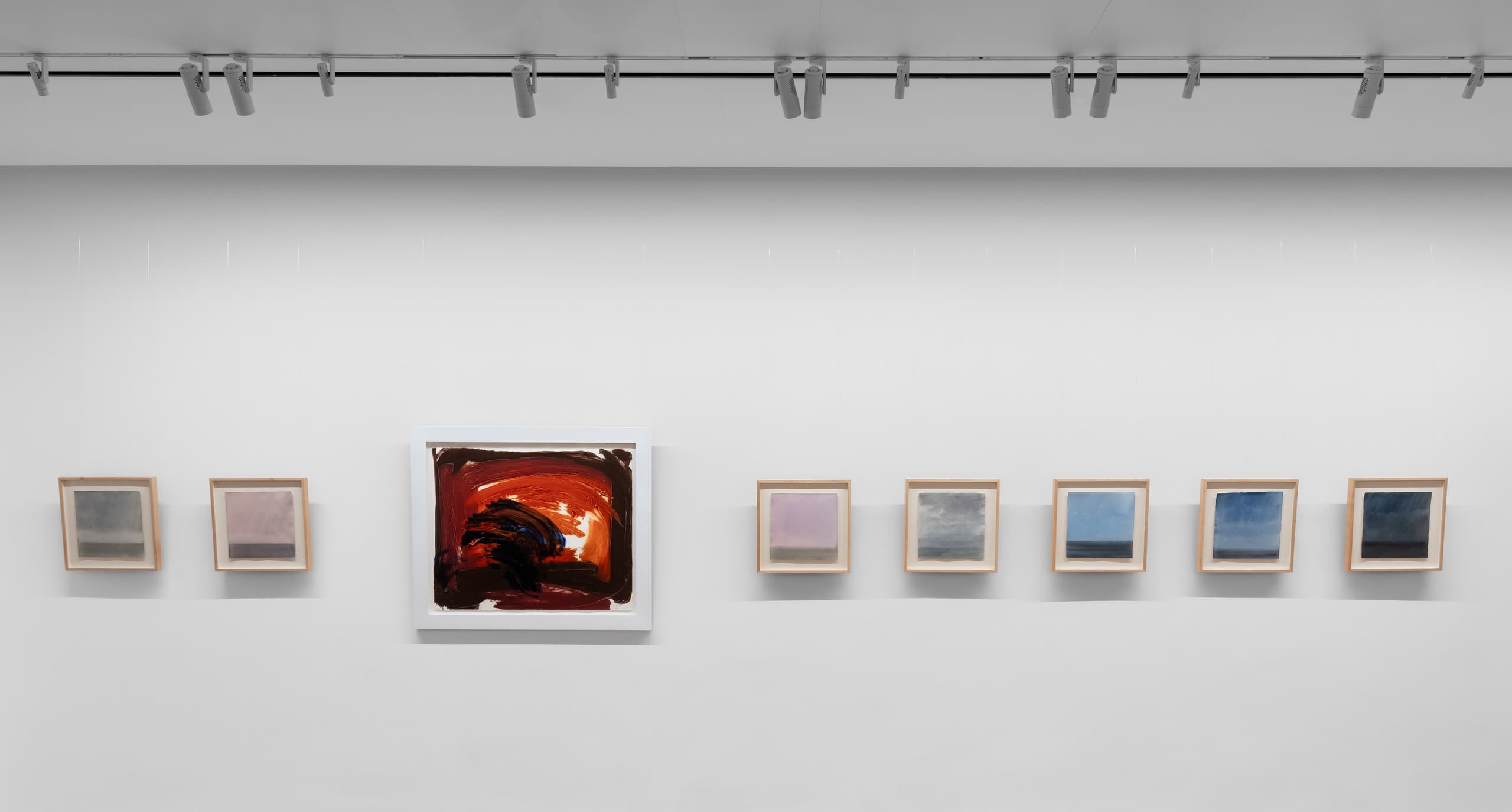
Framing Light brings the work of Adam Leef into dialogue with that of Howard Hodgkin, exploring landscape, memory, colour and light through two distinct artistic approaches. Curated by Maya Binkin, the exhibition examines not only how artists depict light, but also how light shapes the experience of looking. Presented at the ERCO Showroom in London, the exhibition combines painting with a dynamic Tunable White lighting installation that continuously transforms the atmosphere of the gallery and the perception of the artworks on display.
At the heart of Framing Light is a simple but compelling question: how does light influence the way we see and experience art? Through the changing qualities of illumination, visitors encounter the same works under constantly evolving conditions, revealing new colours, details and emotional responses over time.

In the following interviews, artist Adam Leef and curator Maya Binkin share their perspectives on the exhibition, the role of light in artistic and curatorial practice, and the opportunities opened up by ERCO lighting solutions with Tunable White technology.
Artist Insights: Adam Leef
My move to the UK at the end of 2024, after receiving a Global Talent visa as an artist, began with two months at the Xenia Artist Retreat in Hampshire. Walking through the fields and immersing myself in the local landscape gave me a new understanding of the English landscape tradition, particularly the work of Constable and Turner - the unique light, colours and subtleties that are so evident in their paintings and studies, both in oils and watercolours.
These two painters, who revolutionised landscape painting and paved the way for so many artists who followed, had a tremendous influence on my practice in its early days. They encouraged me to go outside and study my own surroundings- the Mediterranean. From 2012 to 2022, I worked continuously, often on a day-to-day basis, on the cliffs overlooking the Mediterranean, learning its unique physicality, light and colours.
I like to describe the English (Hampshire) Suites as a “Mediterranean painter’s ode to the British landscape tradition.” This series gave me the opportunity to work within a different harmony from the Mediterranean, which is my home, or the Atlantic, which I was introduced to through my wife, who is originally from Brazil. British light has a harmony very different from both the Atlantic and the Mediterranean. The sun has much less intensity, and the landscape is often dominated by clouds, greys and purples, alongside the mossy greens and earthy browns of the land.

When I first learned about ERCO lighting with Tunable White technology, my immediate thought was that this is the future of exhibition space and gallery lighting. Anyone interested in art history and the biographies of artists knows how deeply their local light and geography can influence their practice. Think of the Dutch light of Rembrandt and Vermeer, Cézanne and Matisse travelling to southern Europe in search of Mediterranean light, or the California sun experienced by Diebenkorn and the Bay Area painters. These are just a few examples of how light becomes physically embedded in an artist’s experience and visual language.
Working with ERCO on this project, and using Tunable White lighting, allowed us to experience both my works and Hodgkin’s works under shifting light, from warm 3200K through to 5000K. In a way, it simulates the changing outdoor conditions that an artist experiences while working in the landscape, or the changing light coming through the window in the studio.
The warmer light accentuates the warmer colours in the works - pinks, purples and earthy tones - while the cooler light brings greater emphasis to blues and other colder ones. What is particularly wonderful about ERCO’s lighting is that the CRI remains so high throughout the cycle. The quality and integrity of the colours remain outstanding, while the changing light simply brings different moments and different works to the foreground, always retaining the general quality and harmony of the work as a whole.


Light to artists is what acoustics are to musicians. It is the physical yet invisible matter that allows our work to reveal its richness, depth, nuances and subtleties. Collaborating with ERCO has strengthened my appreciation for how much art lighting technology has developed. As a painter, my favourite light will always be natural light, which is so rarely possible to have in exhibition spaces.
To experience such high-quality lighting that can also be adjusted according to the specific needs of a particular series, or even an individual work, has opened my mind to the possibilities available to us today. It can change not only the way I think about presenting my own work, but also the possibilities for galleries and institutions more broadly, allowing each exhibition and viewing experience to become as individual and accurate as possible.
I believe the best exhibition lighting should be almost unnoticeable - so natural and organic that you don’t think about it, but instead remain completely focused on the experience of the art itself.
The collaboration with ERCO gave us the possibility to take that premise further. Even though the lighting shifts and changes throughout the exhibition, it does so in service of the experience of looking. Hopefully, the changing light encourages the audience to slow down, look more closely and pay attention.


Curator Insights: Maya Binkin
Here you have two artists who both treat light as a subject in their work, but in very different ways. Adam Leef’s light feels closely observed and studied, unfolding slowly, whereas Howard Hodgkin’s response feels almost instantaneous and spontaneous. Of course, Hodgkin spent a great deal of time perfecting his technique in order to achieve that sense of spontaneity, but that immediacy is ultimately what we, as viewers, experience.
Bringing the two artists together allows us to consider not only the different ways in which light can be depicted and perceived, but also the emotional responses it can unlock in us. The contrast between Leef’s long observation and Hodgkin’s expressive immediacy became the starting point for the exhibition.
There is a rich history of artists exploring light, and this exhibition is very much shouldered by that tradition, while looking at it from a particularly British perspective. Leef chooses to celebrate British light, which has often been seen as somehow inferior to, for example, the brilliant light of the Mediterranean, where he is from. Here, its mutability and subtlety become its strength.
There is also, of course, a precedent for artists removing the canvas altogether. In the work of Dan Flavin or James Turrell, light itself becomes the medium, and our response to the environment it creates becomes the subject.
Lighting an exhibition is already an intrinsic part of the curator’s work. Collaborating with ERCO has given me the opportunity to bring that normally invisible element of my practice to the foreground and put it into flux, creating a shifting environment in which to encounter the art. In that sense, the light is no longer simply illuminating the exhibition but becomes part of its curatorial narrative.

As well as the poetry of experiencing a cycle of light, transitioning from dawn through to dusk, there is a very physical consequence on the eye to changing the quality of the light. Details that become visible within a warmer, yellower spectrum may recede under a cooler, bluer light. In darker conditions, highlights become more pronounced, while brighter light can draw out details within the shadows.
This dance of light allows visitors to experience the full breadth of the works. Different details, colours and depths reveal themselves depending on where you are in the cycle, so the experience of a painting is never entirely fixed. We can also consider the conditions in which the artists themselves were making these works, whether outdoors or in the studio, environments far removed from the sterile, controlled conditions of the gallery. The shifting light brings something of that instability back into the viewing experience, making us conscious of just how much our perception of an artwork depends on the conditions in which we see it.
Curators and artists, and anyone working in a creative field, should always remain dynamic, looking for new propositions and expanding into new forms of collaboration. I’m excited by what ERCO’s Tunable Lighting can offer curators, who are essentially creating a narrative through which visitors experience an exhibition.
Lighting is enormously important to how successfully that narrative is conveyed. The possibility of making light itself malleable, allowing it to shift, respond and become part of the storytelling, opens up exciting new possibilities for serious exhibition-making. Rather than simply illuminating the art, lighting can help shape atmosphere, emotion and the way a visitor moves through and responds to a space. For me, this feels like an exciting new line of curatorial enquiry, and one that deserves to be explored much further.


Nuance.

Thank you Maya and Adam for your insights.


