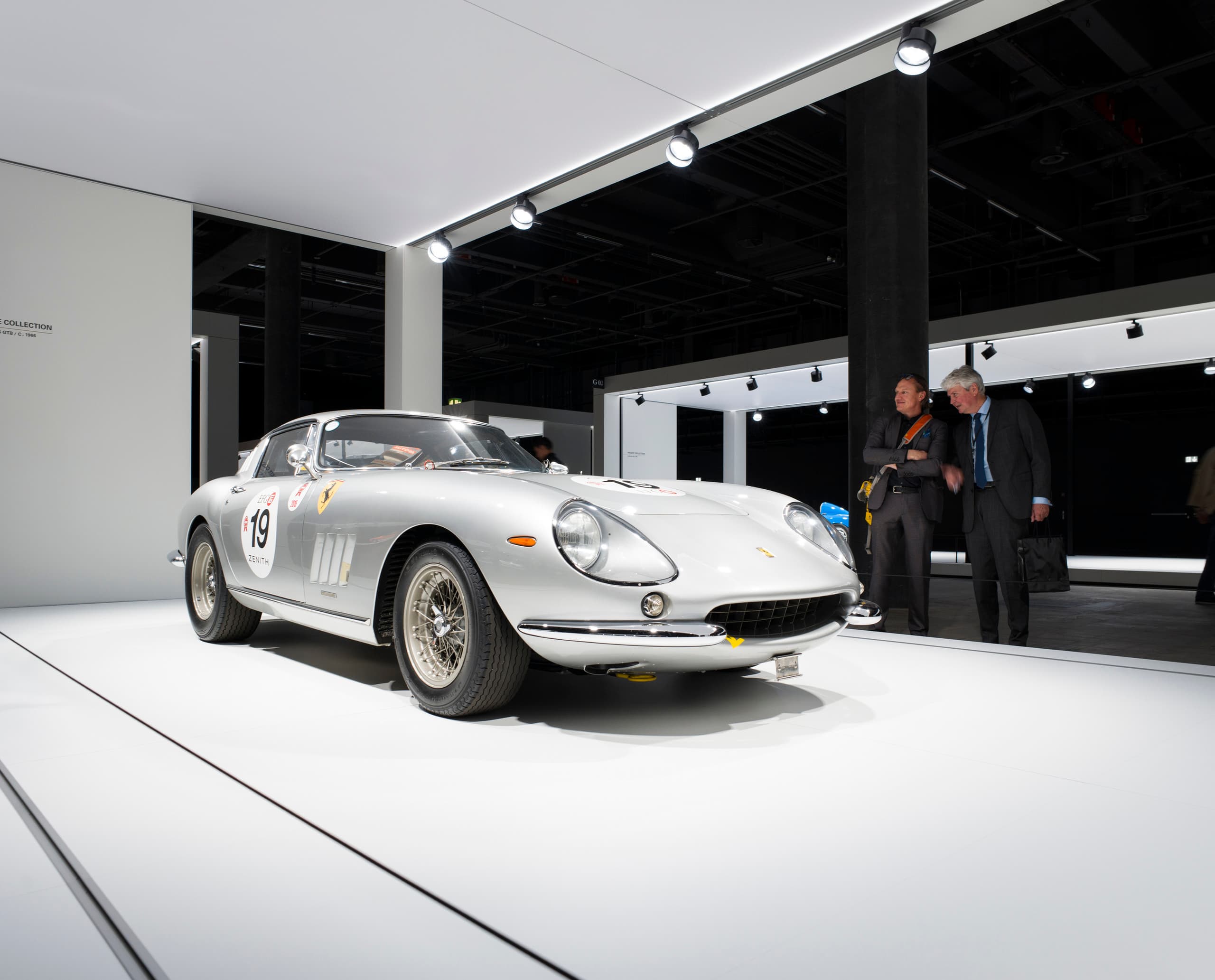
Grand Basel—custom-designed lighting for exclusive collectors' automobiles

Curved edges of light trace the aerodynamic body shape on azure-blue paint and the polished chrome parts sparkle brilliantly. Can cars be art? A question that answers itself in the presence of automotive rarities such as the 1958 Citroen DS "Le Croisette". The cabriolet could be seen together with many other beauties at the Grand Basel, a new show for exclusive, classic cars.
This video is hosted on YouTube. Loading it connects to Google and may set cookies.
The fair presents the vehicles as if in a gallery. Nothing should distract from the exhibits.
Mark Backé, Director of Grand Basel
If aesthetics alone are not enough, the fact that the "Déesse", with its central hydraulics for suspension, steering and brakes wrote engineering history, may prove the relevance of the exhibit. As symbols of progress and objects of desire, classic cars always represent the zeitgeist of their creation—and, thanks to limited availability, have long enjoyed the status of both collector's items and financial investments. Accordingly, it seems only reasonable that the Swiss exhibition company MCH Group, organisers of the world's leading art fair Art Basel, are focusing on this issue with their new event. After all, who else could draw on a comparable depth of experience with highly aesthetic and costly exhibits, but also with a correspondingly exclusive audience?


The concept of the Grand Basel, which celebrated its premiere from 6 to 9 September 2018, is also based on strict selection. More than one hundred automobiles will be shown—but never more than two or three selected vehicles from a dealer or collector will be positioned in one of the "frames" that make up the exhibition architecture: immaculately white, frame-like platforms that are sealed above by opaque stretch film. This homogeneous form of presentation also includes staging of the exhibits with light. In order to convey an optimal visual impression of shapes, colours and materials, both "live" and through the media via photo or film, the technical parameters for quality of light were defined at an early stage in the design process. Responsible for this was the engineer and lighting designer Andreas Seiler who planned the lighting and other technical elements on behalf of the Berlin design company Blue Scope.


We couldn't find a product in the market that met all our criteria.
Andreas Seiler, lighting designer at 360x media
One challenge was the desire to travel with the entire exhibition architecture. Like Art Basel with its international offshoots, Grand Basel will also make stops in Miami, Hong Kong and other locations in the future. For the technology this means: it must not only be portable and efficient to assemble and disassemble, but must also comply with the various power grids, regulations and safety requirements of the host country. To avoid mixed lighting situations in naturally illuminated exhibition halls, the lighting designers specified a daylight-similar light with a 5700K colour temperature—but also very good colour rendering of Ra≥90. Further specifications included dimming control on the housing and flexibility with regard to the beam angle.


Potential suppliers, including ERCO, were contacted for this custom lighting solution. At ERCO the possibilities of individualizing product ranges and developing sophisticated special luminaires are brought together as part of the company's "ERCO individual" service. The option proved to be a winning formula: the responsible ERCO lighting consultant rapidly presented a prototype based on the Parscan spotlight series that already largely met the requirements. Later, during extensive sampling at the client's premises in Basel, the individualized Parscan spotlights finally prevailed in a direct comparison: not only through precise adherence to all technical specifications but also thanks to the product design and the winning visual impression. After a few days at the fair Mark Backé still remains enthusiastic: "It's amazing how well the concept functions," says the director of the Grand Basel. "Working with the spotlights in the frames as the exclusive light sources throughout the hall."