Museu de Cultures del Món, Barcelona

The Museu de Cultures del Món (Museum of World Cultures) in Barcelona presents outstanding works from around the world in medieval Catalan buildings. Architecture and art are set off perfectly thanks to the ERCO lighting tools Optec and Pollux.
A death mask from Ghana, a Buddha statue from Burma, an incense holder from Guatemala. Selected non-European ritualistic and everyday objects are cherished as sought-after collector's items on the international art market. Compared to modern Western works though they are subject to other sets of rules. Because most objects are not signed they usually cannot be assigned to specific artists – their value is defined according to the collections that housed them. The Museu de Cultures del Món makes works from several renowned institutes such as the Folch Foundation and the Ethnological Museum Barcelona accessible to the interested public.


The Museu de Cultures del Món serves as a platform for the preservation, presentation and communication of the artistic heritage and knowledge of cultures from Asia, Africa, America and Oceania. The permanent exhibition shows a quintessential selection of around 500 works, such as an “Apa’apai” club from Polynesia which was brought to Europe in the 18th century by seafarer and explorer James Cook.
Temporary shows are also presented about scriptures for example and their role within their corresponding cultures. The entrance zone of the museum also has an area with free access that accommodates changing presentations, e.g. about the Indonesian shadow play Wayang Kulit.


The Museu de Cultures del Món is located on the Carrer de Montcada, a road renowned for historic buildings. The museum itself is housed in the Casa Nadal and Casa Marquès de Llió, buildings with histories stretching over many hundreds of years. The Nadal House was designed as a medieval palace with an inner courtyard, a gallery on the first floor and a facade with tower, and accommodated the Barbier-Mueller Pre-Columbian Art Museum for many years. The Marquès de Llió House assumes the design of a noble residence from the 8th century and also has an inner courtyard, gallery and tower as well as a prestigious staircase. The building housed the Barcelona Design Museum for several years. Extensive reconstruction and renovation was required to convert these two houses to their current use, including the restoration of coffered ceilings from the 14th century and the construction of interlinking elements between the previously separate buildings.
Antonio Sainz from Haz Luz 17 was commissioned with the lighting design for the Museu de Cultures del Món. His main challenge was to illuminate the historic buildings and artefacts in such a way that architecture and art both came into their own without competing with each other. This achievement was made possible using the ERCO lighting tools Optec and Pollux, which feature specially developed photometric systems that enable the luminaires to be adjusted precisely for optimum beam alignment. As an added consideration, the exhibits needed to be presented so as to allow the observer to lose himself in their contemplation. ERCO LED technology renders objects in brilliant colors and brings out every nuanced hue of the materials and patterns of each item. Importantly, it also satisfies the stringent conservational criteria applied to precious historic artefacts that are easily damaged by excessive exposure to light, as the LED light guarantees a spectrum free of IR and UV components for optimal protection of the artwork.
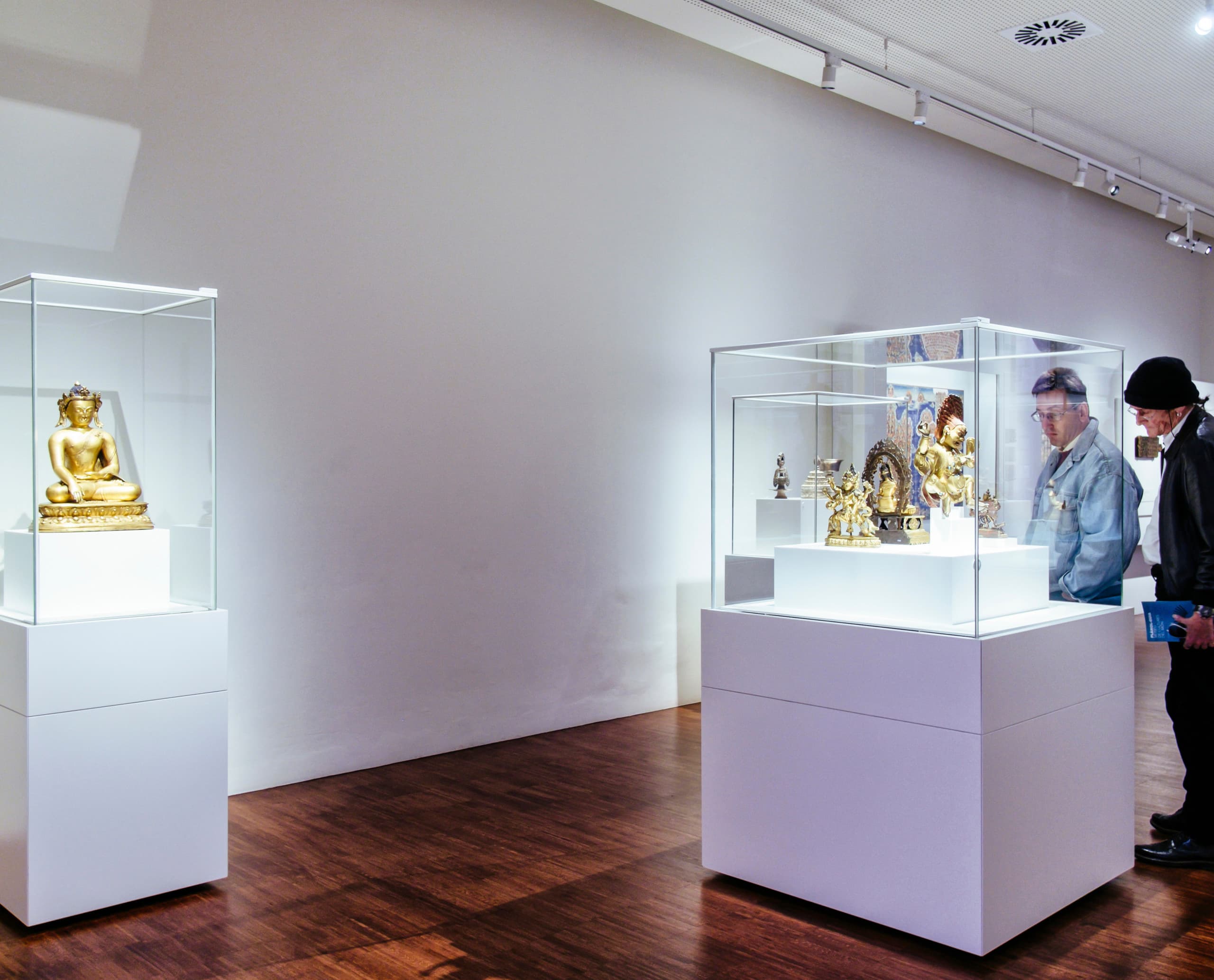
As often found in archaeological and ethnological museums, the Museu de Cultures del Món presents many of its exhibits in display cabinets. Here both general lighting of the room and accenting the objects with spotlights had to be ensured. Even though the cabinets are illuminated externally, no reflections from either the light or windows must occur on their panes. Due to reasons of conservation the temperatures in the cabinets must also remain constant.

ERCO LED lighting tools are the ideal solution thanks to their heat dissipation to the rear of the luminaire. The tops of high display cabinets can also be used for light guidance with the use of frosted panels. When the directed light of a spotlight penetrates the semi-transparent material, it creates diffuse ambient lighting with precision accents. This approach is used at the Museu de Cultures del Món, for example, to set off a collection of African masks with uniquely expressive illumination.