LED luminous flux maintenance: definition and values
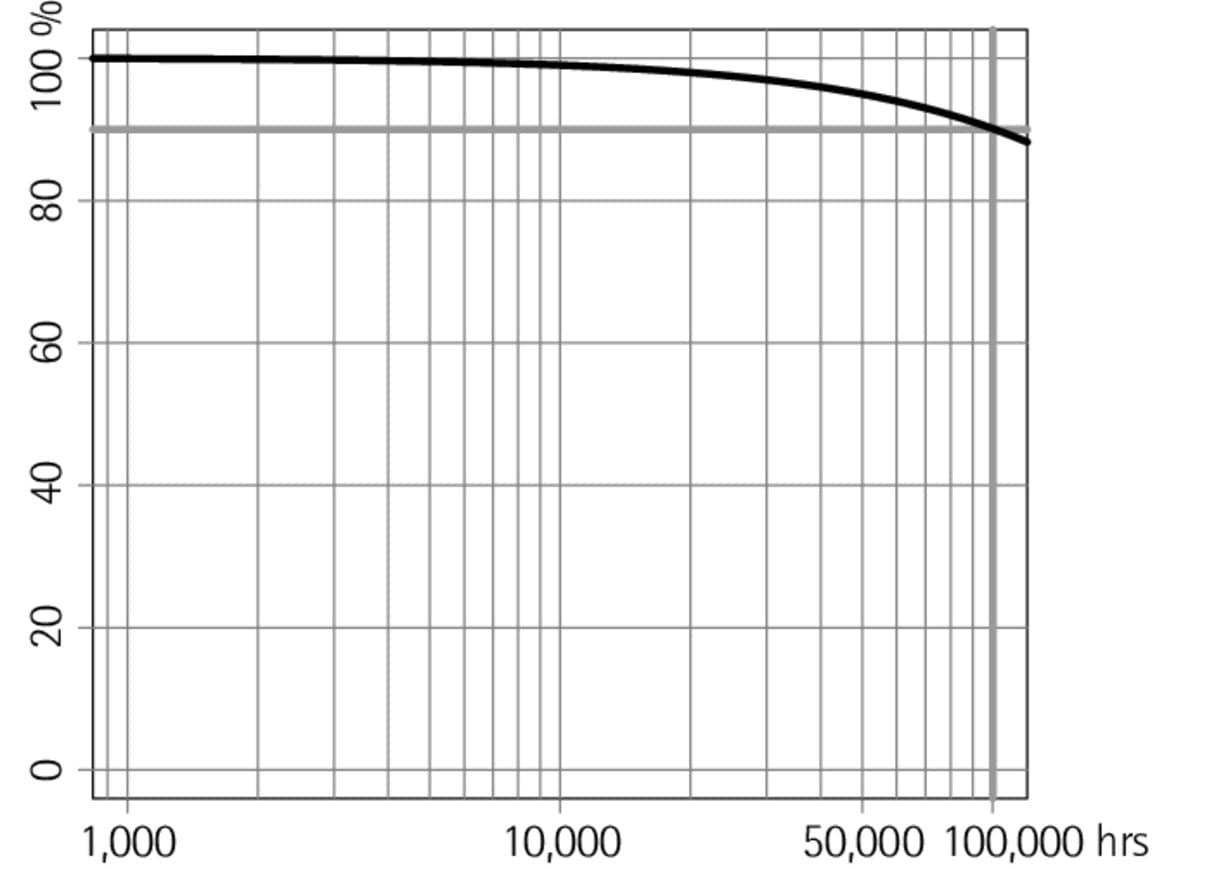
LEDs, as with other light sources, are subject to ageing, causing the luminous flux produced to somewhat decrease. The LED luminous flux maintenance is a statistical parameter that describes how much of the original luminous flux is still emitted after a specific number of operating hours. This decrease is indicated via the L and B values as well as the operating hours in consideration. Both the L value and B value provide no information about the very rare total failure of an LED, the so-called "failure rate".


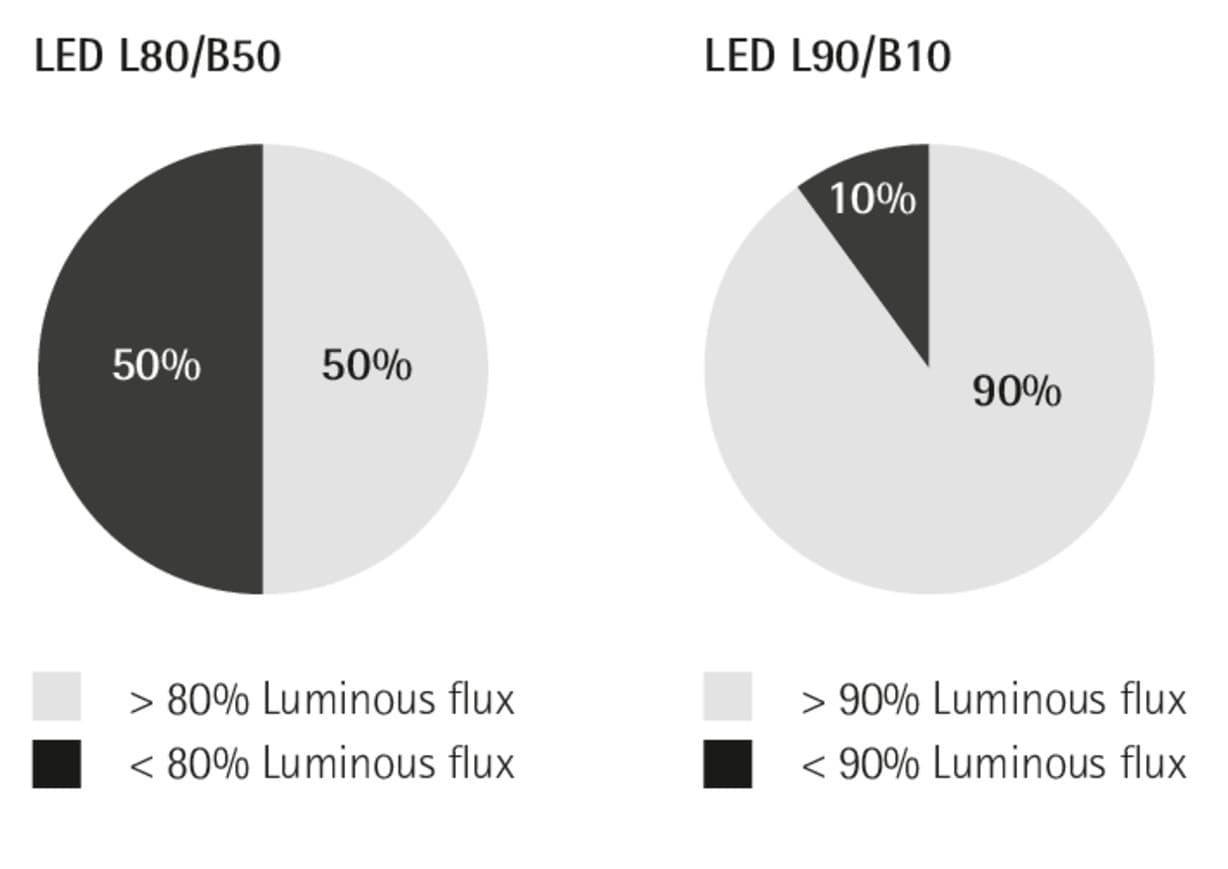
Luminous flux maintenance: What are the L and B values with LED luminaires?
The luminous flux maintenance of the mounted LEDs is indicated via the L and B values as well as the operating hours considered.
Example: L90 B10 up to 100,000h
This means: after 100,000 operating hours, 10% (B value) of the LEDs emit less than 90% (L value) of their original luminous flux. The other 90% (100% minus B value) of the LEDs still have more than 90% of their original luminous flux. The B value thus describes the percentage of LEDs that fall below the limit of luminous flux as defined by the L value.
Note: If no B value is given, this means B=50. "L90 100,000h" therefore means "L90 B50 100,000h".
In layman’s terms this means: up to 100,000 operating hours, 50% of the LEDs emit less than 90% of their original luminous flux.
How are the L and B values determined with LED luminaires?
To determine the L and B values, the luminous flux of an LED is measured over at least 6,000 hours according to the IES LM-80 standard. Then, according to the IES TM-21 standard (Projecting Long Term Lumen Maintenance of LED Light Sources), it is extrapolated to a maximum of 6 times the measurement duration according to LM-80. To obtain values for 50,000 operating hours, at least 50,000 / 6, i.e. around 8,334 hours, must be measured. For comparison: one year of continuous operation corresponds to 8730 hours.
For some LED types, there are now also valid measurements that can be used to calculate a forecast for 100,000 hours. The forecasts are based on certain operating conditions, e.g. ambient temperature and current applied. For example, luminous flux maintenance can be significantly extended beyond the forecast period with a lower LED current flow and optimized thermal management.
What is the difference between luminous flux maintenance and service life?
Luminous flux maintenance predicts which percentage of the LEDs have a certain decrease in luminous flux after a certain time. Often a specification such as L90 B10 at 50,000h is wrongly interpreted to mean that 10% of the LEDs have failed after the specified operating hours. However, the B value designates the percentage of LEDs whose luminous flux is below the L value after the operating time. With a specification of L90 B10 up to 50,000 hours, even these 10% of LEDs can still have 89% of the original luminous flux. The LEDs and thus the luminaire itself can still be operated.
Interesting:
In contrast to luminous flux maintenance, the failure rate specifies which percentage of LEDs have completely failed after a specified operating time. High-quality LEDs however have a very low failure rate of, in some cases, 0.1% up to 50,000 hours. This means: after 50,000 operating hours, 1 in 1000 LEDs has failed.
Quality factors of a luminaire with regard to LED luminous flux maintenance and service life
Well-designed luminaires are thermally constructed so that they always remain below the critical operating temperature for the respective LEDs with proper operation. If an LED gets too hot, e.g. due to very high current flow or poor thermal management, irreparable damage is the result. The design of a luminaire thus determines how well the luminous flux is maintained over a long period of time. The design of the control gear, LED module and heat dissipation are interdependent.
Here is a summary of the essential criteria:
- Quality of the control gear: do these supply the specified current over the entire operating time?
- Current supply to the LED: the higher the current, the greater the heat generation (which can damage LEDs).
- The spacing between individual LEDs must be matched to the optic above them and to the thermal conductivity of the metal core PCB of the LED module.
- The surface and configuration of the heat sink or luminaire housing must reliably dissipate heat to the environment for each approved type of mounting.


