The concept of zonal lighting analyses the activities in offices and provides architectural lighting complying with standards.
Lighting design by comparison
Lighting design by comparison
Can office lighting be attractive and cost-efficient at the same time?
Stringent normative specifications and traditional design approaches with only uniform general lighting and without perception hierarchies lead to unsatisfactory lighting solutions in offices. This results in a lack of consideration of the specific use of the area and a monotonous overall impression. In contrast to quantitative lighting concepts, perception-orientated lighting design in offices is based on the zoning of rooms according to specific needs.
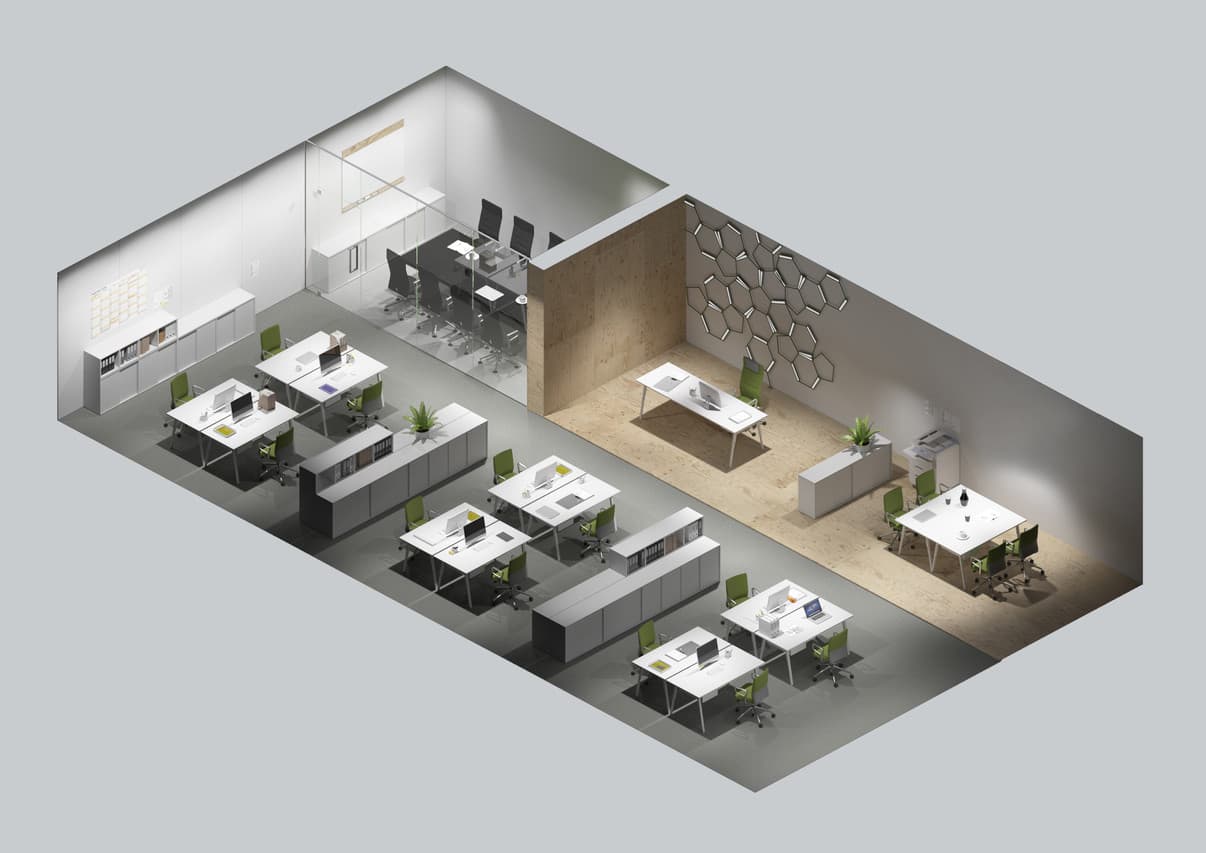
Qualitative lighting design for offices
Zonal lighting analyses where the user needs which light: luminaires with good glare control and simultaneously high cylindrical illuminances, light the workstations, enable good visual comfort and achieve good facial illumination. Illuminated vertical surfaces ensure a bright spatial impression and balanced contrast conditions for work on screens. Illumination of the circulation zone in the central aisle allows pleasant orientation.
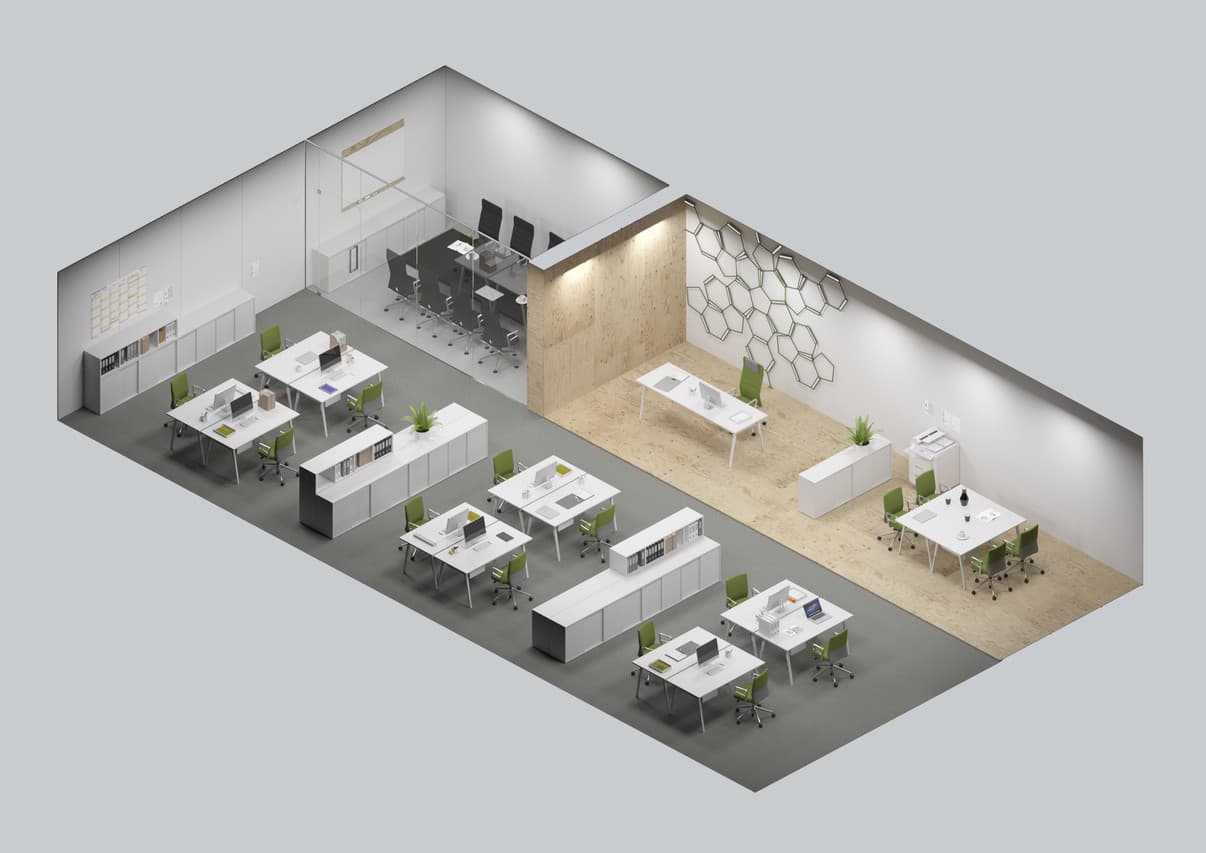
Conventional lighting design for offices
In contrast to zonal lighting, a matrix solution with panel lights does not consider the visual task of the user. Furthermore, energy requirements increase for adequate lighting because of the generally high horizontal illuminance levels. The low-contrast appearance in the space also appears undefined and promotes fatigue.

Luminaire arrangement with qualitative lighting design
For energy-efficient, zonal general lighting, the positions of the luminaires on the desks should be coordinated. Wallwashers are mounted at the front of the office to establish a bright spatial impression. Whereas, the central aisle zone features linear general lighting with oval flood light distribution.

Luminaire arrangement with conventional lighting design
The uniform matrix module represents a compromise for the individual lighting tasks of desks, circulation zone and discussion zone. The wide light distribution also creates a flat impression in the room.

Summary
The effectiveness of low-maintenance lighting with LEDs can be increased with zonal lighting design. Energy requirements can also be reduced with perception-orientated lighting concepts. Simultaneously, improved visual comfort and a more appealing spatial impression are created.