LED lenses – a core competence of ERCO

Precision work for ultimate light quality
Crystal clear and lightweight, they are no bigger than a chocolate bar – and yet they hold the secret of the superior efficiency and light quality of ERCO’s LED lighting tools.
Development, design, toolmaking, production, assembly – every aspect of the process is handled under one roof. The short distances help to secure ERCO‘s edge in technology and quality. In order to cope with the rise in demand for LED spotlights, ERCO has started up an automated production cell where parts are handled entirely by an industrial robot. From removal of these parts from the injection moulding machine for laser cutting right through to optoelectronic testing before finally placing the finished parts in transport trays – all steps combine to produce a fascinating technical ballet.

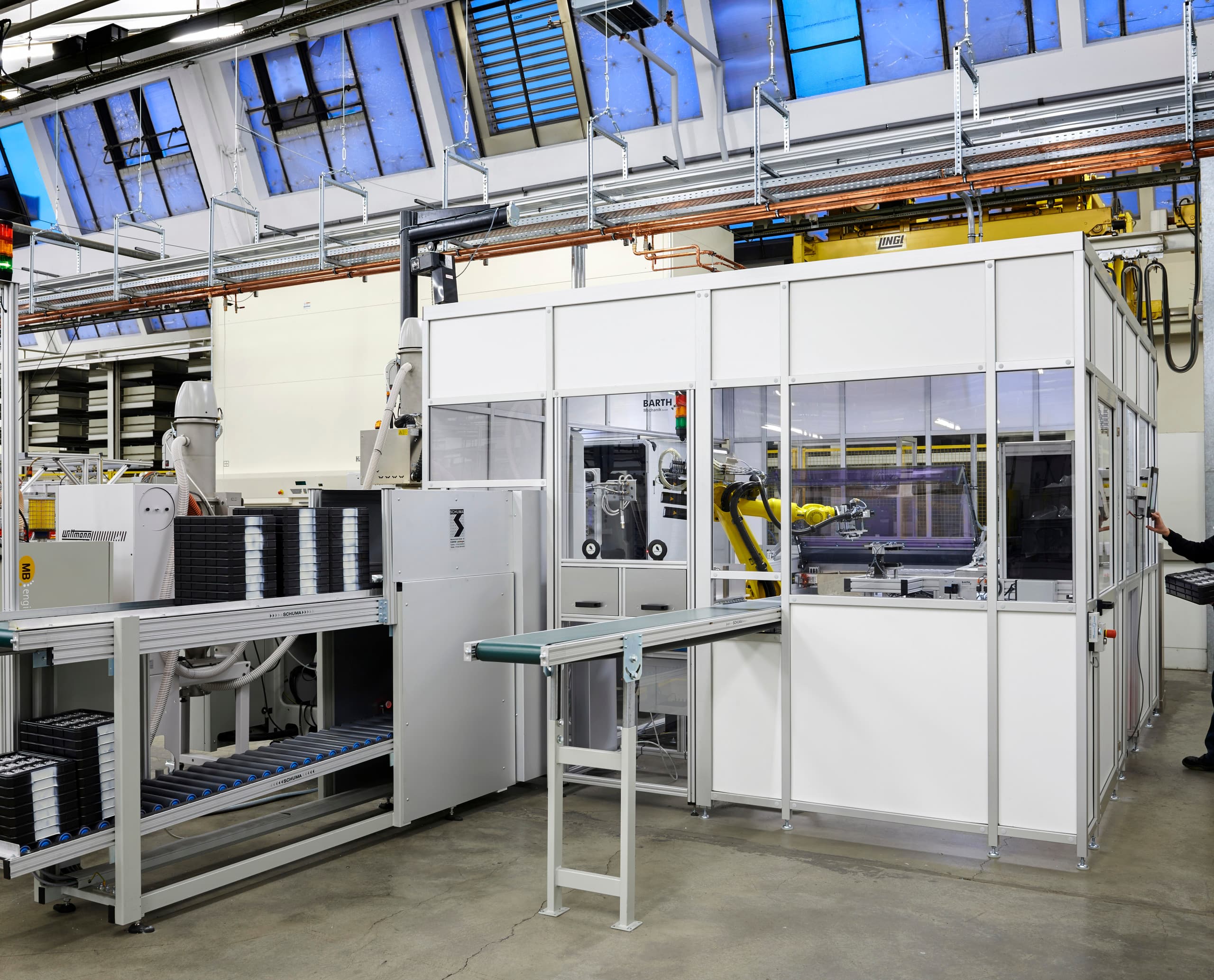
The grade of the optical parts is checked piece by piece through digital, optoelectronic testing. An automated process in which faulty parts are ruthlessly sorted out and, if necessary, the system fitters are alerted to potential process errors.
Setting up the robot’s track system is a precision job. The fitter defines the end points of travel and action and the safety distances to the machine parts in manual operation to allow the robot’s own control computer subsequently to calculate the optimum path.

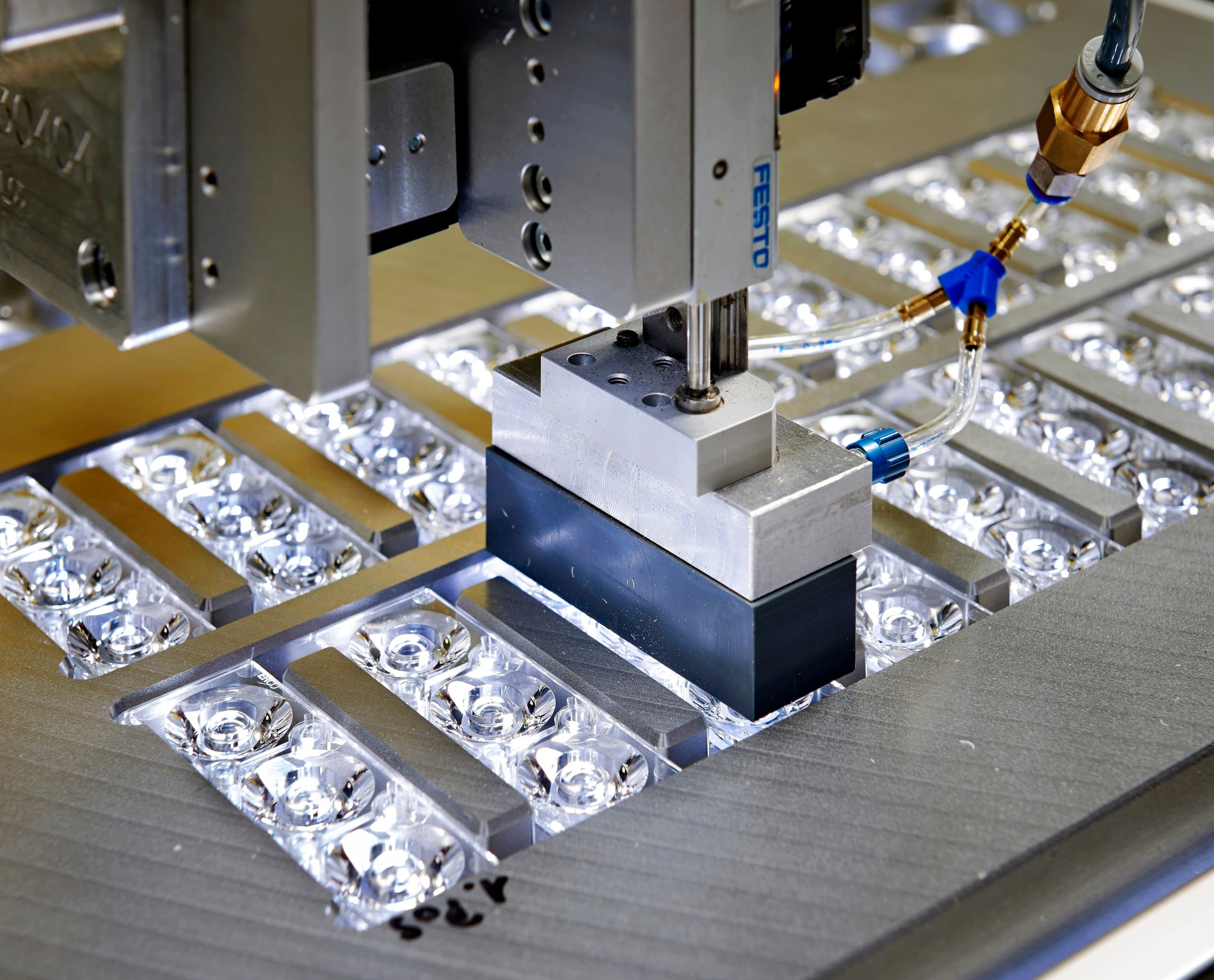
Every 36 seconds, the robot removes a new casting from the polished steel injection mould, after holding the two-piece die closed for injection moulding at a force of 1100kN. The part still consists of two collimators at this point, joined by the lug.
Suction grippers on the robot arm carefully place the optical precision parts – here a triple collimator – in a feeding frame for optoelectronic testing.
Lichtbericht 96, May 2013