Art history comes alive with light: ERCO in the Museum of the Cathedral in Florence

The Museum of the Cathedral in Florence, which recently reopened after a huge expansion project that doubled its dimensions, hosts the world’s greatest collection of sculptures of Florentine Middle Ages and Renaissance. Its architecture and artworks are perfectly staged thanks in no small part to ERCO light enhancing their artistic quality.
Officially known as “Cattedrale di Santa Maria del Fiore”, Florence Cathedral is one of the most iconic and popular tourist attractions in Italy. Every year, around 1.4 million people visit the “Duomo”, which was built between 1296 and 1436 and includes the adjoining Baptistry. As well as these two monuments, the cathedral complex today includes the Museum of the Cathedral, or “Museo del Opera di Santa Maria del Fiore”, founded in 1891. Devoted to the history of the Florentine landmark, its design and interior bear the signatures of great Italian artists such as Giotto, Brunelleschi, Ghiberti, Donatello and Michelangelo, whilst giving as much attention to the many sculptures made specifically for the cathedral.

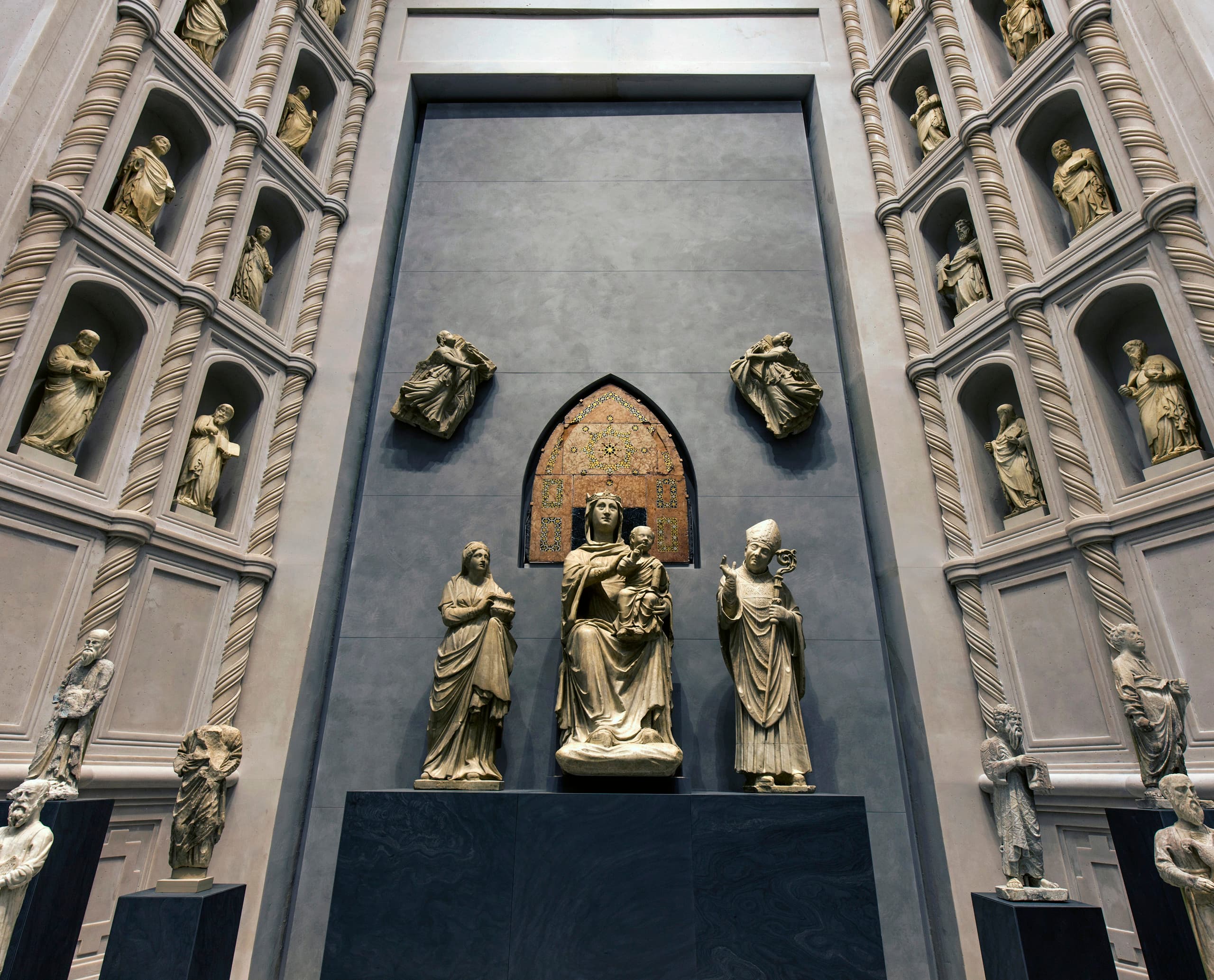
After two years of intense restoration and enlargement, managed by Florentine architects Guicciardini & Magni Architetti, the beautifully refurbished museum is today a major tourist attraction and another feather in the cap of the Tuscan art metropolis. This is thanks in no small part to another artist, Massimo Iarussi, who left his mark with a skilfully executed lighting design that does justice in every respect to the world’s greatest collection of sculptures of Florentine Middle Ages and Renaissance on display here. His sophisticated lighting concept is based on ERCO lighting tools that once more demonstrate brilliance, precision and efficiency. To present close to 750 works covering nearly 6,000sqm of exhibition space in just the right light, the museum’s 25 halls were equipped with a total of 1,500 ERCO lighting tools in 50 different configurations. The main protagonists are spotlights from the Parscan and Pollux ranges, used with different wattages and a variety of light distributions. In some places, Iarussi deployed Quintessence and Skim downlights, Optec and Pantrac spotlights as well as Lightscan outdoor projectors. All luminaires emit warm white light at 3000K.
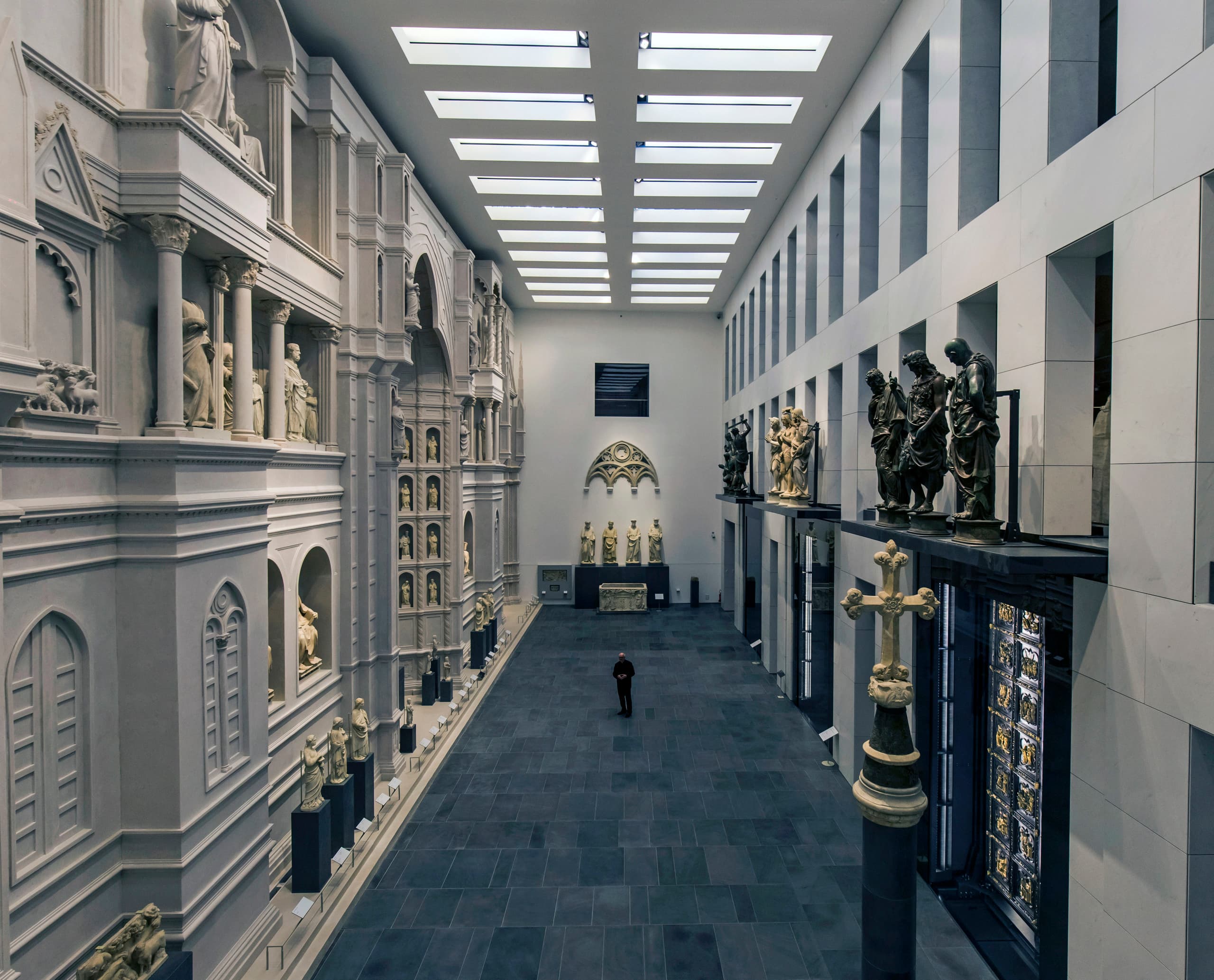

Director Monsignor Timothy Verdon explains the significance of light in his museum this way: “Lighting is a major component to the overall experience of artwork in any museum. But when your collection consists almost entirely of sculptures, light management is absolutely critical to the presentation. Because whilst paintings invariably require uniform, glare-free illumination, the three-dimensions and shadow zones of statues and reliefs call for differentiated lighting influenced by the periods in which they were created, their artistic style and their original context.”
The wisdom of his point is brought home particularly well by the centrepiece of the presentation, the breathtaking “Salone del Paradiso” (Hall of Paradise), which extends across three floors and is illuminated with light coming from the skylights. The spectacular dimensions of this light-infused interior evoke an outdoor environment that makes it ideal for the presentation of artwork originally created for the exterior, such as the celebrated bronze doors of the Baptistry, designed by Lorenzo Ghiberti in the first half of the 15th century. However, the hall is dominated by a spectacular, full-scale model of the Cathedral’s medieval façade, which was never completed and ultimately dismantled. Faithfully reconstructed, many of the preserved statues and reliefs were integrated into the model and returned, as it were, to their original location. The diffused natural light in this space is complemented by accent light from powerful Parscan projectors focused, from different angles, onto the object and the individual sculptures.


Meanwhile, the lighting in the “Sala della Maddalena”, another masterpiece of the museum, is entirely different. Here stands Donatello’s poignant sculpture that once graced the interior of the Cathedral, the Penitent Saint Mary Magdalene. In the darker room, the statue is contrasted with directional light, to further emphasise its dramatic features. A similarly evocative concept is found in the room dedicated as “Tribuna di Michelangelo”, where the only exhibit is the unfinished Pietà Bandini, a late work by the legendary Renaissance master. Here, the height of the room is exploited to simulate a “divine light” coming from above to illuminate the sculpture, urging the visitor to focus on the central element of this group of figures, the body of Christ.


Throughout the museum, the designers installed highly creative lighting solutions, each precisely crafted to enhance the dramatic effect of the exhibits, whilst reinforcing in compelling detail the harmony of form and content, with emphasis on their aesthetic and didactic values. Light in the Florentine museum, more than elsewhere, creates an experience that demonstrates in an exemplary fashion – without detracting attention from the exhibits – the potential of modern lighting design. The wide variety of ERCO lighting tools, designed to enable combination in any configuration, provided a solid base for implementation of this sophisticated lighting concept. At its heart, however, it derives its compelling character from the brilliance of ERCO light and the precision of ERCO LED technology, to the delight of experts and the public alike.


Mathias Remmele works in Berlin as a freelance publicist and exhibition curator for topics relating to architectural and design history. As a critic he focuses on contemporary developments in these areas. He is also a lecturer at the School of Art and Design in Basel.