Building form and materiality at night: façade lighting for museums
Bring urban spaces to life at night, too
Light façades so that buildings become visible, orientation emerges, and striking buildings appear calm and present.
Structure large surfaces with accents and emphasise details such as columns, cornices, or material textures.
Use well-shielded luminaires with precise lighting technology to avoid light pollution.
Choosing the right light distribution
Choose the light distribution to suit the task at hand. Control precisely whether the light accentuates, models, or works across a surface.
Lighting façades perfectly
Narrow light distributions are ideal for small façade details. They let you set precise accents and highlight architectural elements in a targeted way.
Wide light distributions are ideal for large surfaces. This lets you light façades evenly and create a calm overall effect.
Work with a variety of light distributions. Diverse light distributions make lighting concepts possible, from sharp accents to soft washes of light.
In this way you can develop exterior lighting that is nuanced, efficient, and suited to the architecture.
Lighting façades evenly
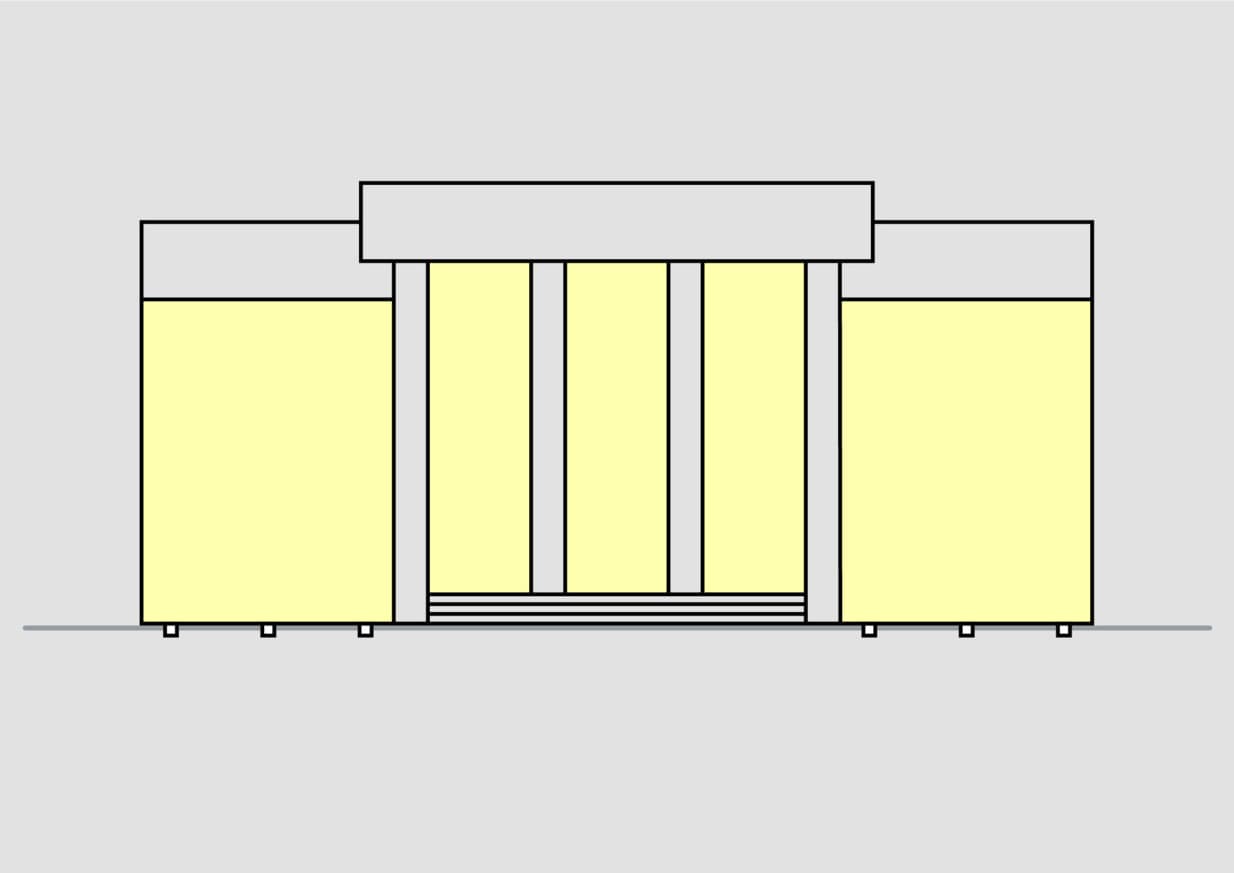
Use wallwashing to light façades evenly and calmly, emphasising the architecture as a whole.
Use vertical surfaces to targeted effect. Even modest illuminance levels create a strong impression of brightness in outdoor spaces — especially in rural settings, but also in urban contexts.
Plan with wide luminaire spacing. This reduces the number of luminaires and supports an efficient solution.
Choose wallwasher light distributions to achieve an even effect across the façade. Specialised luminaires direct the light precisely onto the vertical surface.
The result is a clear, prestigious, and economical façade lighting scheme.
Model the façade structure with grazing light
Use grazing light to bring out the surfaces of façades with a sculptural quality. The light strikes the surface at a shallow angle, revealing its textures. Emphasise reliefs, joints, and material textures in this way. Historical façades, natural stone, or textured surfaces thus stand out to particularly striking effect.
Use grazing light to targeted effect. It creates depth and shadow, with a striking impact from a distance.
Choose the right lighting tools. Façade luminaires and recessed floor luminaires, for instance, are ideal for guiding light close to the surface. In this way you stage architecture not only with brightness, but also in a way that does justice to the material and brings out its character.

Making façade articulation visible through light: shaping the contours of buildings
Respond to the geometry of the architecture with light. Take spatial patterns as the starting point for your lighting design. Follow prominent structures where these provide clear cues.
On neutral surfaces, work more freely with light patterns. The result is lighting that makes the spatial order visible and supports the architecture with precision.
Take reflectance into account deliberately
Assess the surface before choosing the size of the luminaires. White render, grey concrete, and red brick, for example, reflect light to differing degrees. As a result, they do not create the same impression of brightness under identical lighting.
For this reason, match the luminous flux, luminaire size, and light distribution to the respective material. This achieves a balanced spatial effect and avoids surfaces that are too bright or too dark.
Reinforcing spatial patterns with light
Use regular structures as guidelines for your lighting design. Axes, grids, and repetitions provide a clear order for the lighting.
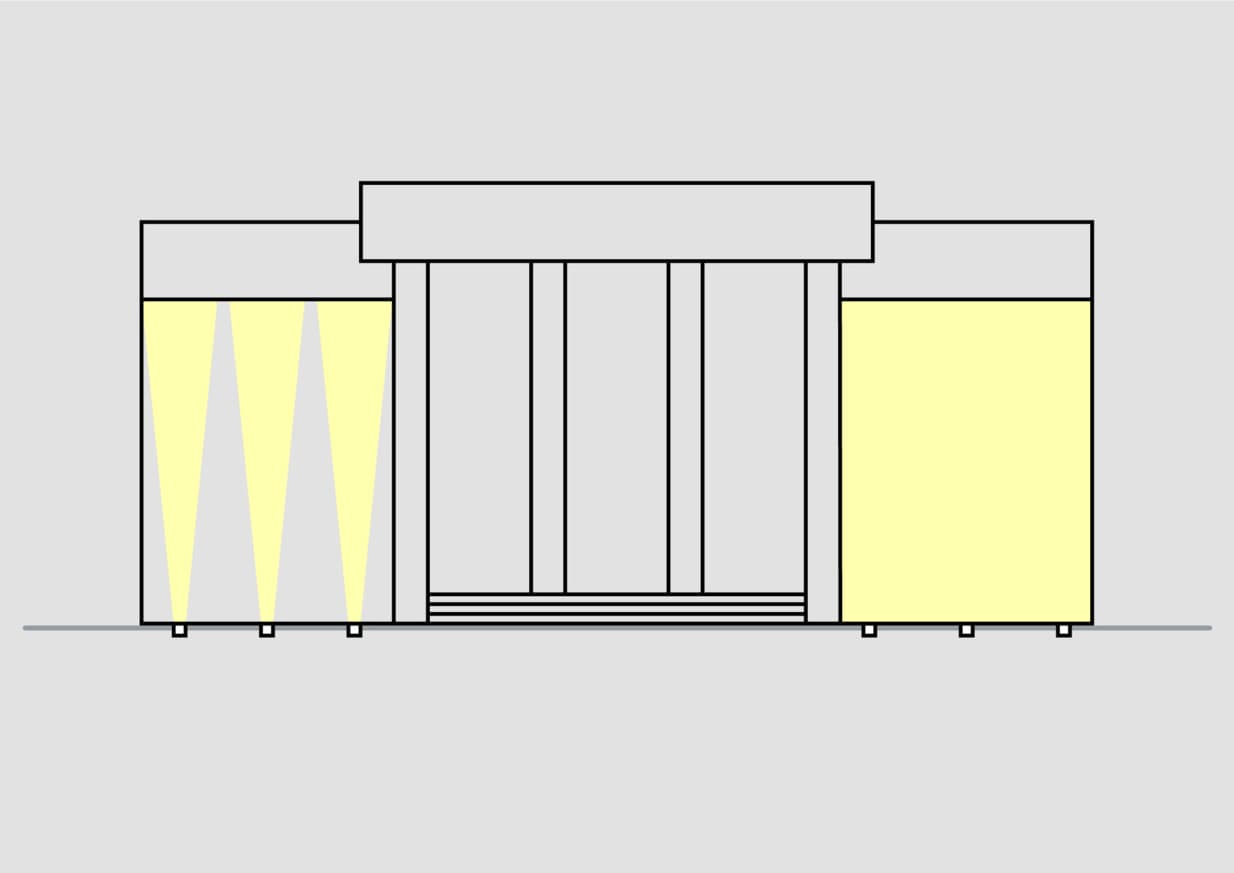
Reinforce the spatial pattern with light to targeted effect. Use uplights, for example, to make façade axes visible.
Take up the grid of the outdoor grounds. Bollard luminaires can extend the architectural structure through their shape, position, and light distribution.
This creates a calm, precise lighting concept. It reinforces the geometry of the architecture and keeps its order legible even at night.
Stage façades in a neutral or complex manner
Staging façades in a neutral manner
Where façades have pronounced articulation, put it centre stage instead. Use a neutral light pattern to do so.
If the architecture is already strongly structured, avoid adding further accents. In this case it is advisable to illuminate the surface evenly and in a balanced way with wallwashers.
This keeps the order of the façade clearly legible. In this way you support the existing architecture without overstating it.
Designing façades with a complex light pattern
Develop bespoke lighting solutions for structured façades. Use the existing spatial pattern as your design basis.
Integrate the light precisely into the articulation of the façade. This achieves lighting that never looks like an afterthought, but becomes part of the architecture itself.
Trace axes, panels, or grids with light. This keeps the structure of the façade clearly recognisable even at night.
Use light in a differentiated way. The result is a complex light pattern that emphasises the architecture and gives it a nocturnal identity all of its own.
Illuminating façades with light patterns
Illuminating façades with a neutral light pattern
Follow the lines of the architecture as you do so. Keep the character of the façade as consistent as possible by day and by night.
Relate homogeneous surfaces to a calm light pattern. This keeps the architecture clear, matter-of-fact, and understated in its legibility.
Avoid overlapping effects where the surface itself already exhibits a strong order. A neutral lighting image supports the existing structure.
Use wallwashers to achieve even, planar illumination. This creates a calm distribution of brightness that preserves the character of the architecture.
Designing façades with their own light pattern
Use neutral façade surfaces as a canvas for light. Light thus becomes a defining design element in its own right. Deliberately transform the character of the surface.
A distinctive light pattern can order the architecture rhythmically, energise it, or reinterpret it. Work with even beams of light and draw a clear, recurring structure onto the façade. Use free light patterns through projection. This lets you develop bespoke images, graphics, or atmospheric effects. For the night, the façade gains an identity of its own.
Think of the neutral background as a canvas.
Design it with patterns of light and shadow, transforming the character of the façade in the process. Light and shadow become the leading players and the dominant design element. Draw on the wide range of possibilities, from an even, rhythmic articulation with beams of light through to free light patterns that you create by projection.
Sculpture garden and outdoor space: long-range impact, branding, and events
Extend the museum experience into the outdoor space for outdoor events. Stage architecture, sculpture gardens, and open-air exhibits with precision. Integrate the grounds into the exhibition concept, creating new qualities of place. Well-designed lighting gives rise to striking museum experiences — from an atmospherically lit garden to a dramatically accented statue.
Host events at your museum
Make yourself visible. Bring art and architecture to life at night! Lit correctly in the dark, sculptures, façades, and outdoor spaces reveal their special presence.
Create visual highlights
Accentuate works of art in gardens, on forecourts, and along pathways with light. Use light as an invitation. The architecture itself can also be a reason to visit. Stage façades to impressive effect. Emphasise the dimensions of the building and bring out architectural elements such as columns with precision. This positions your museum as an appealing cultural brand.
Roll out the red carpet with light
Begin the cultural experience before visitors even reach the entrance. Guide them from the car park across the sculpture garden and into the foyer.
Guiding the way with light
Put pathways in the spotlight so that visitors can find their way intuitively. Illuminate sculptures along the routes to create visual anchors that guide the eye and awaken curiosity about the exhibition. Establish a distinctive, special atmosphere even before the entrance. Light makes the way inviting, safe, and full of experience.
Use light for orientation. Bollard luminaires, path lighting, and accentuated arrival points guide people safely through outdoor areas, enhancing your guests' sense of security. Glare-free light makes pathways easy to read and supports comfortable movement across the grounds. You welcome your visitors in an appealing way and make the journey to the event part of the experience.
You've completed the second lesson — great work!
The most important points
- 1Structuring large surfaces with accents: Use accents to give structure to large façade surfaces and to emphasise details such as columns, cornices, or textures.
- 2Making use of open surfaces: Neutral façade surfaces can serve as a canvas. Patterns of light and shadow create a distinctive nocturnal identity.
- 3The outdoor space as a space for experience: The exterior extends the museum experience and creates new qualities of place for visitors.


Next lesson