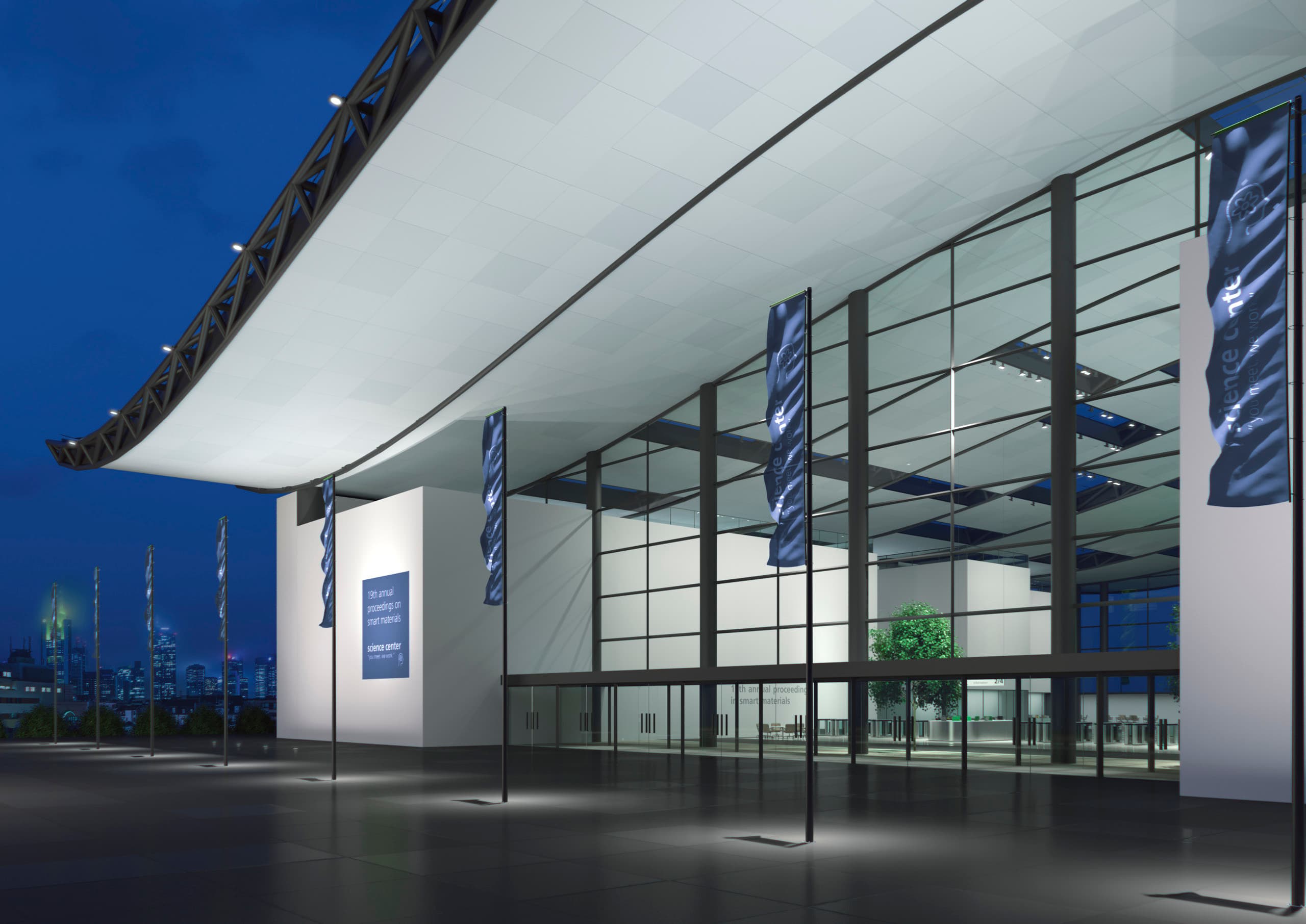
How can light lend public buildings a unique appearance?
Creating landmarks with light
Light emphasizes public buildings in urban environments. Perception-orientated lighting is simultaneously inviting and prestigious.
Creating landmarks with light
Prestigiously displaying with light
Light plays a decisive role when lending public buildings a prestigious and unmistakable identity. It emphasizes the architecture in its urban context. This includes displaying the facade and building structure with light as well as the design of entrance zones, foyers and halls. Differentiated lighting concepts with various light components and qualities of light for the specific functions communicate a sense of value. Premium materials and surfaces are shown to full effect in brilliant light with good color rendering.
Giving roofs a floating appearance with light
Imposing roof constructions are typical elements with the prestigious architecture of large public buildings: large-scale, broad or protruding roof structures set esthetic accents in the urban environment. As canopies they define protected entrance zones, bring together the indoor and outdoor spaces in a foyer and also create special atmospheres in halls. Such roof constructions are emphasized by ceiling washlighting and gain a lightweight, almost floating appearance when illuminated. The ceiling washlighting simultaneously implements glare-free, indirect general lighting.
Creating insights with light
Wallwashing generally means the uniform illumination of vertical surfaces in a room using special wallwash luminaires with asymmetric distribution of light. Wallwashing has a special role with perception-orientated lighting because the natural viewing direction of people focuses on vertical surfaces. Vertical lighting emphasizes the dimensions of large-scale foyers and entrance halls via extensive spatial depth. It also enables transparent architecture to illuminate from within and transforms buildings into nocturnal landmarks.
Creating focal points with light
Prestigious lighting concepts for public buildings are rounded off by displaying objects such as sculptures, colonnades, flags or trees as effective focal points in front of the more planar-illuminated building background. Directed, focused light emphasizes properties such as sculptural qualities or movement not only with its contrast in brightness to the surroundings but also with an interplay of light and shadow. Suitable lighting tools, matched to the architectural conditions, are projectors mounted to masts or the building as well as narrow distribution recessed floor luminaires.


ERCO light guide: Community
Planning tips for design and technology