
Setting precise accents
Use spotlights to clearly emphasize individual exhibits and guide visitors' eyes exactly where you want them.
Choose narrow light beams for this purpose. A lens system achieves very high illuminance levels, especially at small beam angles. Plan the light distribution to suit the object: "narrow spot" is ideal for the smallest details, "spot" for focused accents, and "flood" for larger areas.
Take advantage of the efficiency of the optics. This is how you achieve strong contrasts, a brilliant effect, and precise lighting for art.
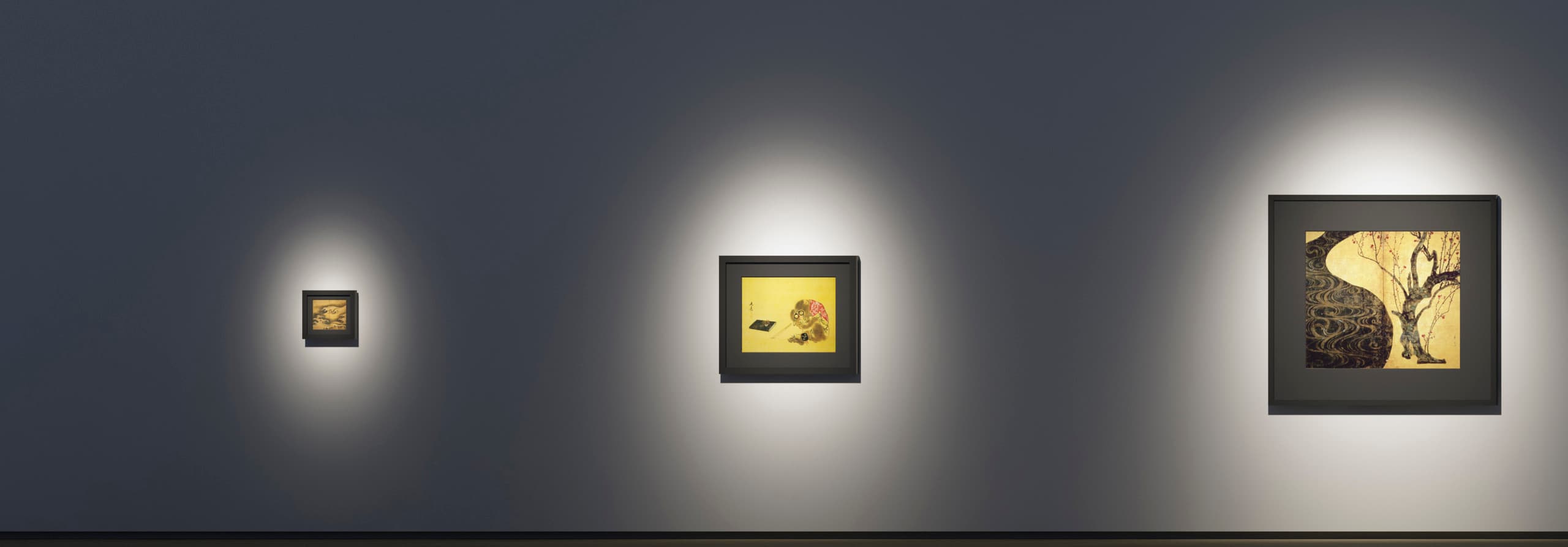
(approx. 6°) Ø 0.4m at a distance of 4m
(approx. 15°) Ø 1.1m at a distance of 4m
(approx. 30°) Ø 2.0m at a distance of 4m
Illuminating large exhibits across their full surface
Use wallwashers to illuminate large exhibits, groups of pictures, or wall areas uniformly from a short distance. If you want to cover large surfaces calmly, broadly, and homogeneously, choose "wide flood" or "extra wide flood".
For elongated works, use oval flood. Match the oval light distribution with its 1:4 ratio precisely to the format. Rotate the lens to suit the hanging: rectangular luminaire heads rotate in 90-degree increments. Round luminaire heads give you the advantage of infinitely variable rotation.
This allows you to align light distribution, exhibit, space, and hanging with precision – efficiently, flexibly, and with a calm effect across the surface.

(approx. 65° x 15°): Ø 5.0 m x 1 m at a distance of 4 m

Oval Flood
- "Oval Flood" is suited to elongated works. Match the oval light distribution precisely to the format at a ratio of 1:4.
- (approx. 65° x 15°): Ø 5.0 m x 1 m at a distance of 4 m
Why "extra wide flood" is no substitute for wallwashing
Use extra wide flood for broad surfaces, but not for uniform wallwashing.
The light distribution does not strike the wall homogeneously over its entire height. Instead, a bright hotspot often appears in the upper part of the wall, while brightness visibly falls off towards the bottom.
If you want uniform illumination of the wall, you should use genuine wallwashers. These distribute the light across the wall in a controlled manner, creating a calm, even backdrop for art and space alike.
Why "Extra Wide Flood" is no substitute for wallwashing
Use Extra Wide Flood for broad surfaces, but not for uniform wallwashing.
The light distribution does not strike the wall homogeneously across its entire height. Instead, a bright hotspot often forms in the upper section of the wall, while the surface falls off visibly towards the bottom.
If you want the wall to be illuminated evenly, you should use genuine wallwashers. These distribute the light across the wall in a controlled manner, creating a calm, even backdrop for art and space.
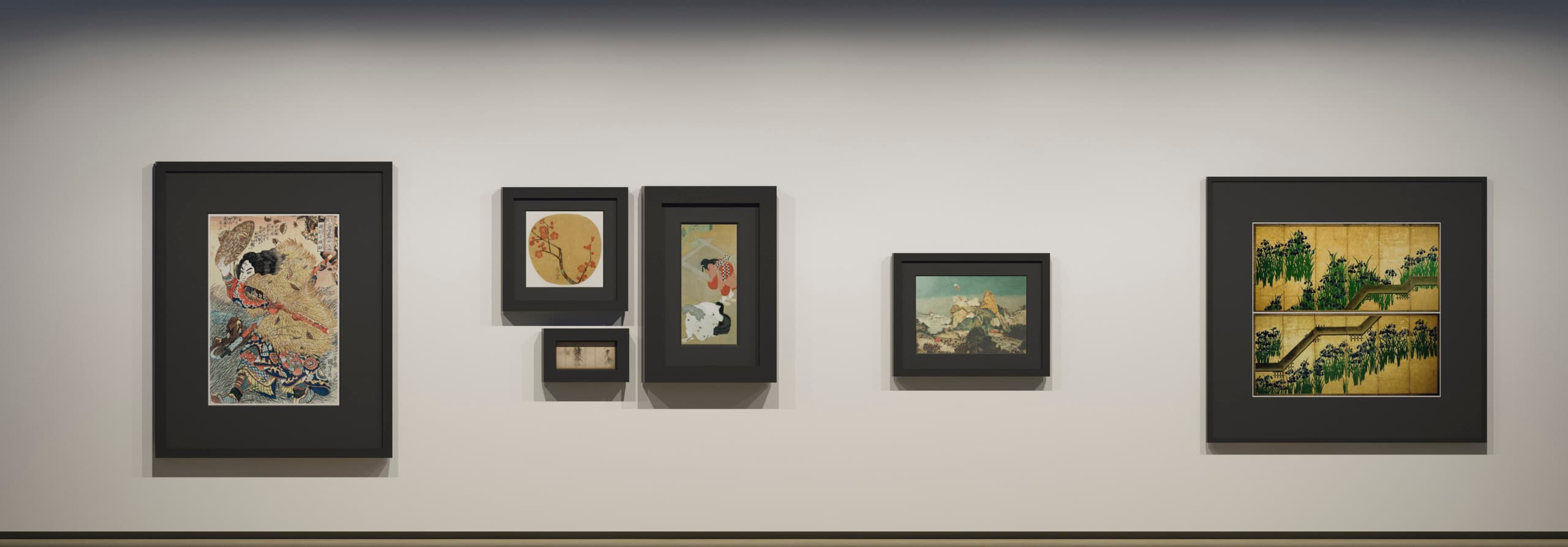
Approx. 6 luminaires over 10 m in a room 4 m high.
Defining projection surfaces precisely
Use framing projectors with framing shutters to present pictures with precision.
Use the framing shutters to set the illuminated area precisely to the desired format. This keeps the edges sharply defined. Plan framing light for crisp edges and strong focus – ideal for pictures in a rectangular format.
Create an intense visual effect. Thanks to the hard, precise contrast with the dark surroundings, the work seems to glow from within.
Lesson complete!
The most important points
- 1Choose the light distribution to suit the exhibit: narrow spot for the finest details, spot for focused accents, flood for larger areas.
- 2For elongated works, match the 1:4 oval flood light distribution precisely to the format.
- 3For even wallwashing, use true wallwashers rather than extra wide flood – otherwise the latter creates an uneven hotspot in the upper area of the wall.


Next lesson