Luminous efficacy: a photometric quantity for the efficiency evaluation of light sources
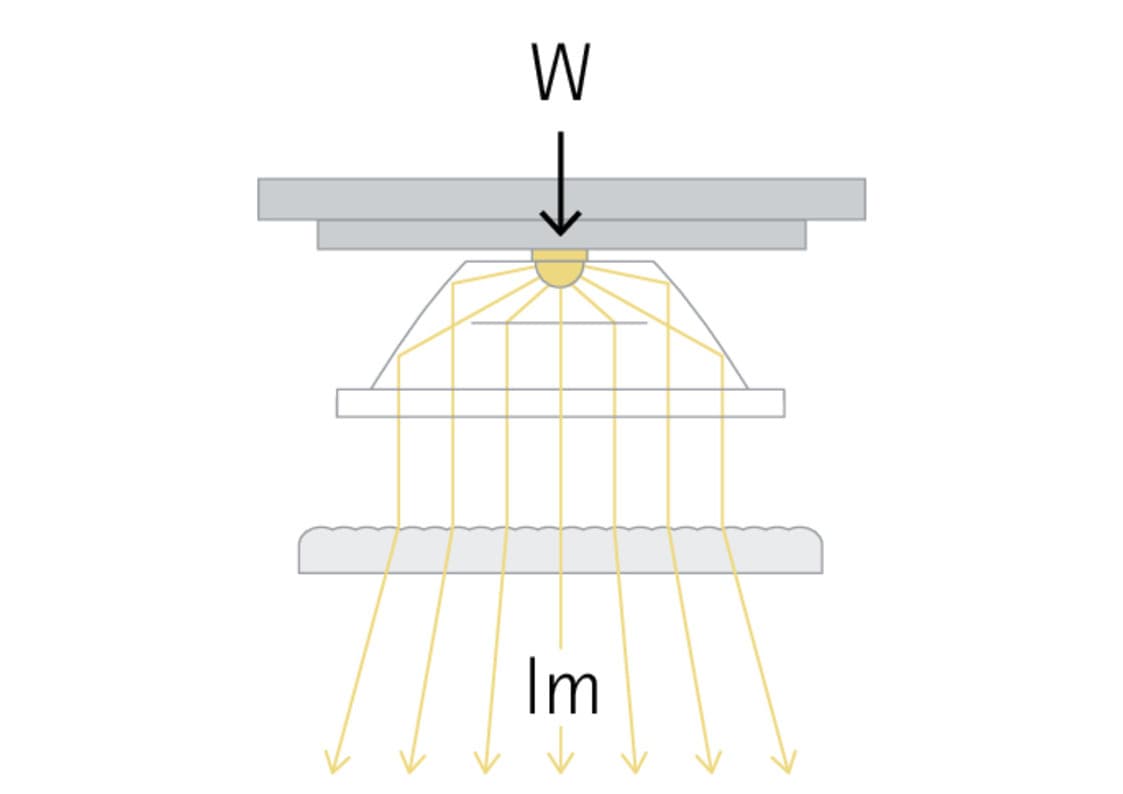
Luminous efficacy is defined as the ratio of emitted luminous flux Φ (measured in lumens lm) to expended electrical power of a light source (measured in watts W). Specified in lumens per watt (lm/W), luminous efficacy is thus a measure for evaluating the efficiency of lamps such as LEDs, or also the luminaire itself including control gear and optic.


How do you calculate luminous efficacy?
Luminous efficacy describes the efficiency of a light source. It is expressed by the ratio of luminous flux emitted in lumens to expended electrical power in watts.
The formula symbol for luminous efficacy is η (Eta).
The formula for calculating the luminous efficacy is:
luminous efficacy (lm/W) = luminous flux (lm)/power consumption (W)
How high is the luminous efficacy of an LED?
The luminous efficacy of a light source can, depending on the type of light source, vary greatly. The maximum value achievable in theory with complete energy conversion into light visible to humans (555nm) would be 683lm/W. The luminous efficacies that can actually be achieved vary depending on the illuminant, but are always far below this ideal value. LEDs achieve better luminous efficacy than discharge lamps for example. As LED retrofit lamps, or even more as LED modules, they achieve high values. LED light sources achieve luminous efficacy of up to 180lm/W.
Interesting:
The efficiency of luminaires is often used as a criterion for sustainability. At least 100lm/W is an important value here. However, especially with accent lighting, the effectiveness, i.e. the lux per watt value Fc/W (lx/W), is more relevant. This is because when illuminating a room, it is important to check where exactly light is needed in order to reduce it everywhere else. This way, light only reaches the relevant target areas. Energy consumption is thus reduced.

