Thinking in lighting functions
Which functions does light adopt in office buildings?
The debate concerning attractive, creatively stimulating and flexible office worlds is in full swing but a considerable part of office equipment is still observed quantitatively—the lighting. Although light is of essential importance in knowledge-orientated work environments that focus on people: light can significantly contribute to the quality of the room and support dialogue and concentration. We show you what lighting concepts look like that meet the needs of a dynamic, digitally networked knowledge society.

Determining the fundamentals
Office lighting needs to fulfil a variety of requirements: in every project designers are faced with the challenge of bringing together normative specifications, economic targets, constructional conditions and design aspects into a single concept. A theoretical model of lighting functions helps to evaluate the quality of lighting not just according to purely quantitative criteria such as illuminance or energy efficiency figures. It separates lighting from the static cubic room to focus on the utilisation of the spacial situation—the interior, the façade and also the exterior.
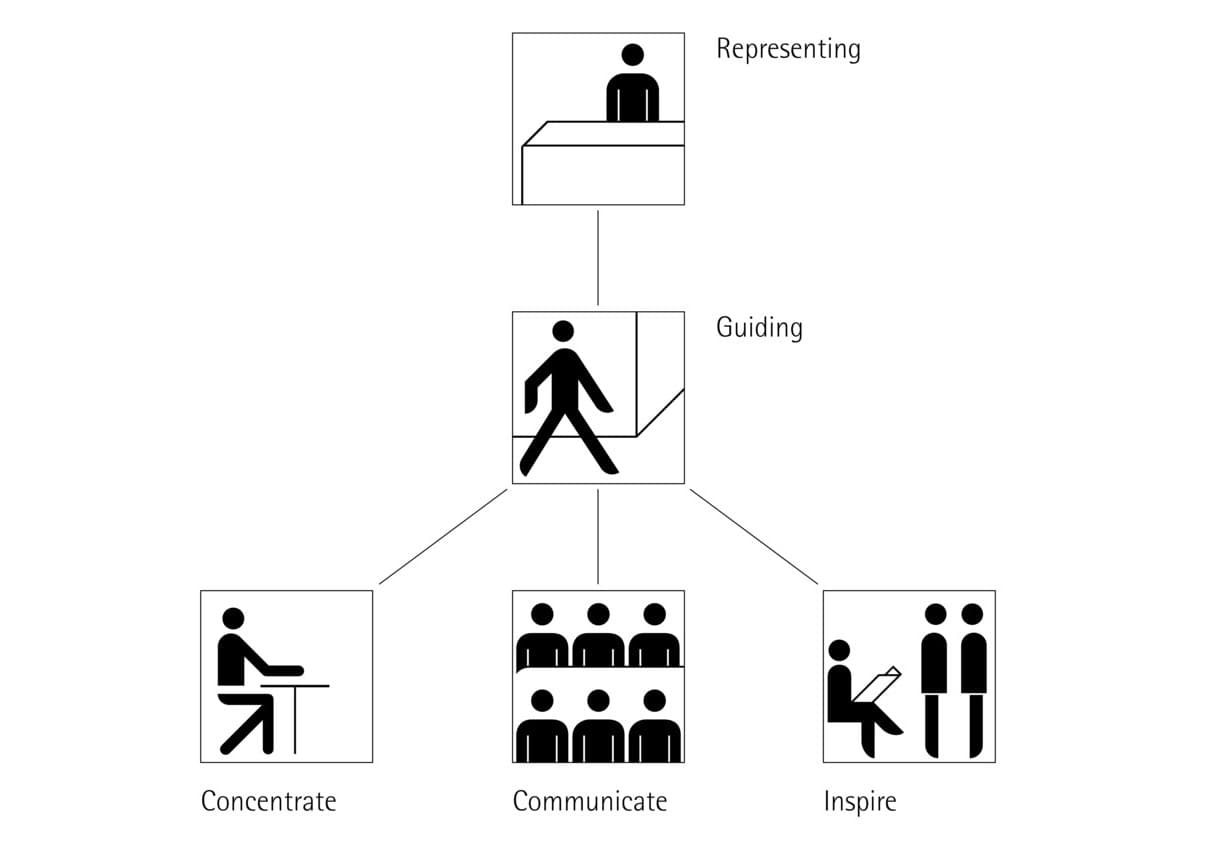
In this way the function becomes clear: should a room area represent, guide, make concentrated work possible, support open communication or provide inspiration and change? The model of the lighting functions enables designers to flexibly respond to a high diversity of architectural situations and work methods within an increasingly dynamic world of work, as well as modularly grouping lighting tasks and scaling room areas according to needs. It is ideal as the basis for qualitative, perception-orientated lighting design. At the start of each lighting project, it is important for lighting designers to ask the following three questions for each required functional area:
- Why do we illuminate? Which corporate-strategic, architectural or functional significance does the room or room zone have?
- What can light achieve? Which office tasks can be supported via lighting to optimise the use of the room?
- What is the ideal lighting solution? Which individual lighting strategy and methods of lighting are suitable as the basis for lighting design?


A comparison of two design approaches
Can office lighting be attractive and cost-efficient at the same time?
Qualitative lighting design for offices
Zonal lighting analyses where the user needs which light: luminaires with good glare control and simultaneously high cylindrical illuminances, light the workstations, enable good visual comfort and achieve good, pleasant facial illumination. Illuminated vertical surfaces ensure a bright spatial impression and balanced contrast conditions for work on screens. Illumination of the circulation zone in the central aisle allows pleasant orientation.
Conventional lighting design for offices
A matrix solution with panel lights does not reference the visual task of the user. Differing forms of work are supported with the same lighting. This is therefore not optimally matched to the needs of all users, and losses in terms of ambience and concentration must be expected. Furthermore, the low-contrast and undefined appearance of the room may cause fatigue and energy needs for sufficient lighting also increase. Find out more about the added value provided by a perception-orientated lighting in the ERCO case study for office lighting.


