Accommodation (eye): Adjustment of visual acuity
Accommodation is the ability of the eye to focus visual acuity on objects at different distances. This consists of an adjustment of the visual organ by deforming the lens of the eye.
In near vision accommodation, the lens is strongly curved. The sphere-like shape has a higher refractive power. With distant vision accommodation the lens is much flatter, thus reducing the refraction of light. The area where the object is imaged is called the fovea centralis. We only see sharply what is projected onto it. The concentration of cone receptors is highest in the fovea, so daytime vision is equivalent to seeing sharply.


How does accommodation of the eye work?
Accommodation is the dynamic near-field and distant-field adjustment of visual acuity. For the process, muscles and fibres curve the lens in our eye. In this way, objects at different distances can be imaged sharply on the retina of the eye.
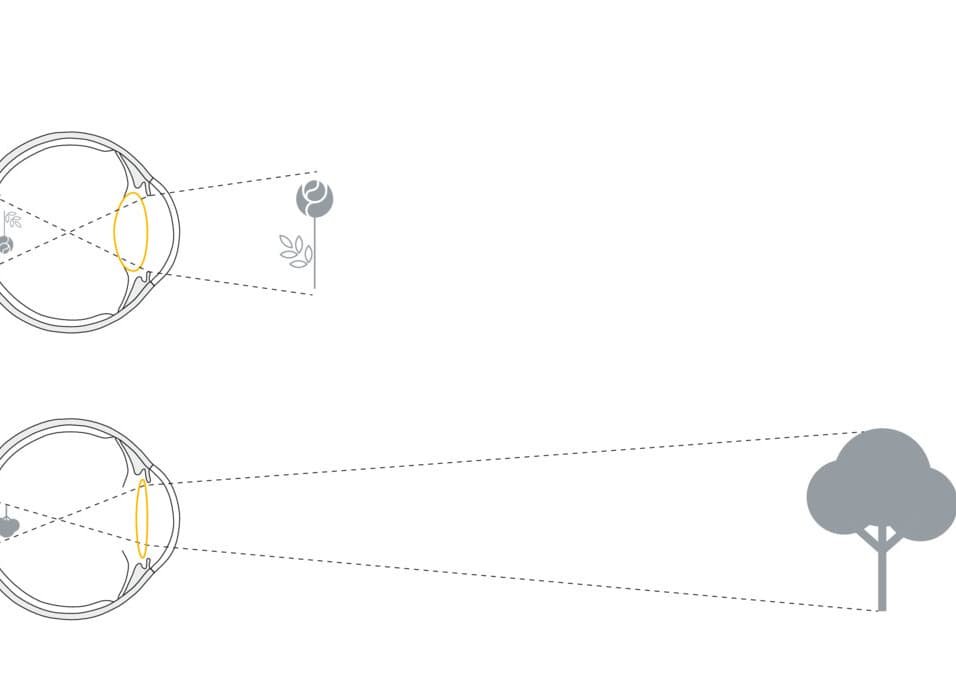
Accommodation is an important step in vision. Distance accommodation is the distance adjustment of the eye. Whereas with near accommodation, the visual organ switches from distance to near vision. Often, accommodation is understood to mean only near adaptation.
The lens in the eye is elastic and convexly curved on its front and rear. This creates a converging lens that focuses the incident light. In this way, a sharp image is created on the retina.
A highly curved lens refracts the light more strongly and enables us to focus on nearby objects (near accommodation). A flat lens on the other hand makes objects at a greater distance appear sharp on the retina (distance accommodation).
What is meant by width of accommodation?
Width of accommodation and accommodation capacity can be used synonymously as terms. What is meant by this is the minimum and maximum distance to the observed object at which a sharp image is still possible on the retina in the eye. The width of accommodation decreases with increasing age. In order to still see objects sharply at close range, optical corrections are required, e.g. the use of reading glasses.
The width of accommodation is expressed in dioptres (dpt). This is the unit of measurement for optical refractive capacity.
What is the difference between adaptation and accommodation?
The eye is able to adapt to different conditions. Thus, it is not only able to regulate visual acuity to the distance of objects to be viewed during the process of accommodation. Even with different levels of light incidence, the pupil and the sensitivity of the retina are adjusted to regulate the amount of light rays. This process is called adaptation.


