The human eye: structure and mode of operation

The eye is one of the most important sensory organs, enabling us to perceive the world visually. An image of the surroundings is projected through a lens onto the rear (the retina) of the eye. Receptors convert the light stimuli into electronic signals and transmit these to the brain. The process of processing and interpreting stimuli is called visual perception.


How is the human eye constructed?
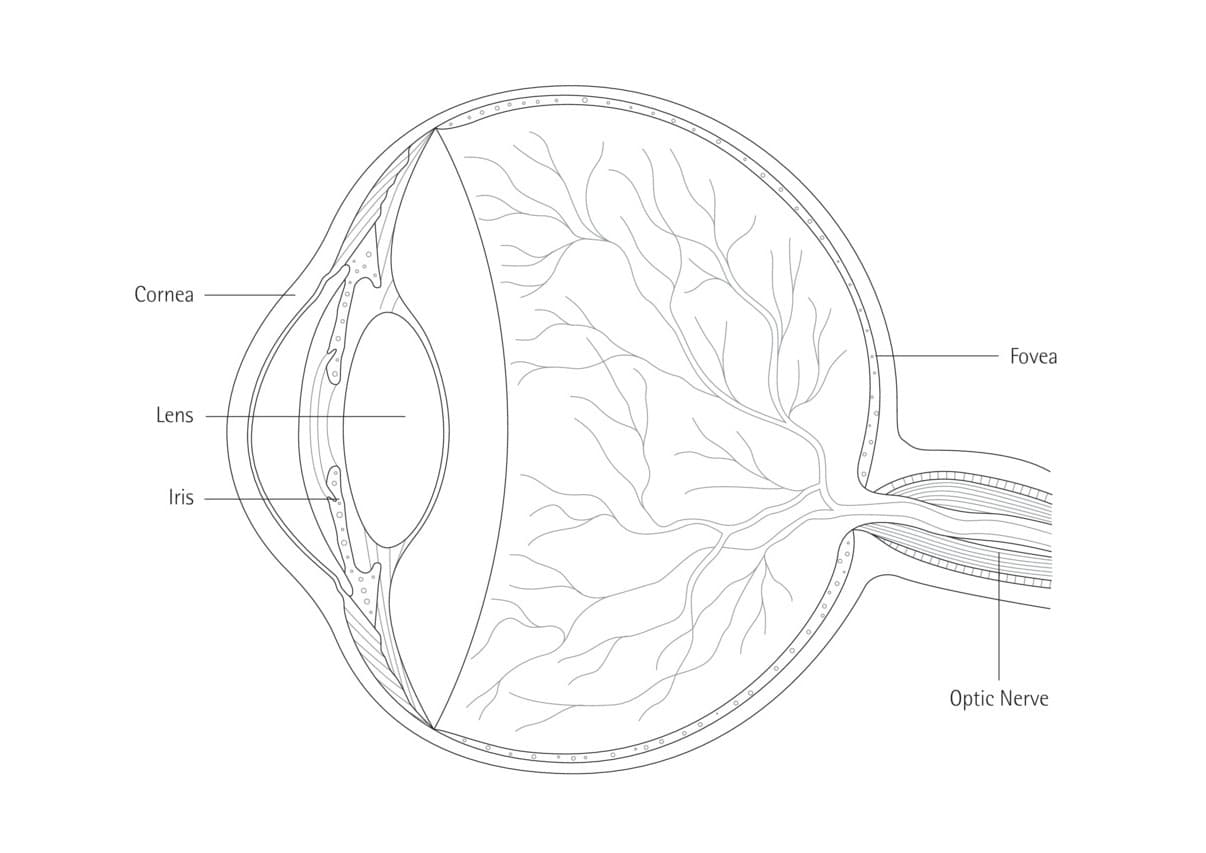
The eye is an optical system. The cornea and the deformable lens project an image of the surroundings onto the rear of the retina. As with a photo camera, this is upside down. The iris regulates the quantity of incident light by reducing or enlarging the aperture of the pupil. In the retina, the incident light stimuli are transformed by receptors into neuronal impulses to be transmitted to the brain via the optic nerve.

What properties does the human eye have?
The eye has different receptor systems for processing optical stimuli. The rod and cone systems are for visual perception. The rods are distributed uniformly across the retina. They are characterised by their high sensitivity to light and enable wide-angle vision at low levels of illuminance (scotopic vision). However, the visual acuity is low and colours are not perceived. The cones on the other hand are mainly concentrated in the focal point of the lens (fovea centralis). They enable crisp, colourful vision at a limited angle of view, but require high illuminance levels (photopic vision).
Current research has shown that there is a further group of receptors in the retina: light-sensitive ganglion cells. These are not used for vision but provide important information about brightness, and therefore the duration of day and night. This perception of ambient brightness plays an important role in the circadian rhythm: morning light activates us, but with the onset of darkness sleep hormones are released to make us tired. Light-sensitive ganglion cells thus control our inner clock.

Good to know:
The human eye has complex capabilities that enable optimal and extensive vision:
Visual acuityis the eye's ability to perceive details in order to see contours and patterns in a sharply delineated way. Accommodationmakes it possible to adjust and focus the visual acuity onto objects at different distances by deforming the lens. Adaptationis the adjustment of the human eye to different luminance levels, i.e. lighting conditions, by dilating the pupil aperture and switching between the photoreceptors.


