Developing a lighting concept: from strategy to dramaturgy
Start by analysing the use, the visual tasks, and the context. On this basis, you develop a lighting concept with a clear strategy and dramaturgy. In the design phase, you determine where the luminaires are positioned and what effect they should achieve. During implementation, you assess technology, efficiency, and precision. This is how structured lighting design takes shape.
Ask your clients questions!
Stage the spaces and take up the architecture
- Should light be integrated unobtrusively or deliberately staged?
- Where do you need particularly good visual comfort?
- Objective: a first clear lighting idea and dramaturgy
A good architect can answer these questions clearly, concretely, and vividly. Not only in technical terms, but also in images and effects.
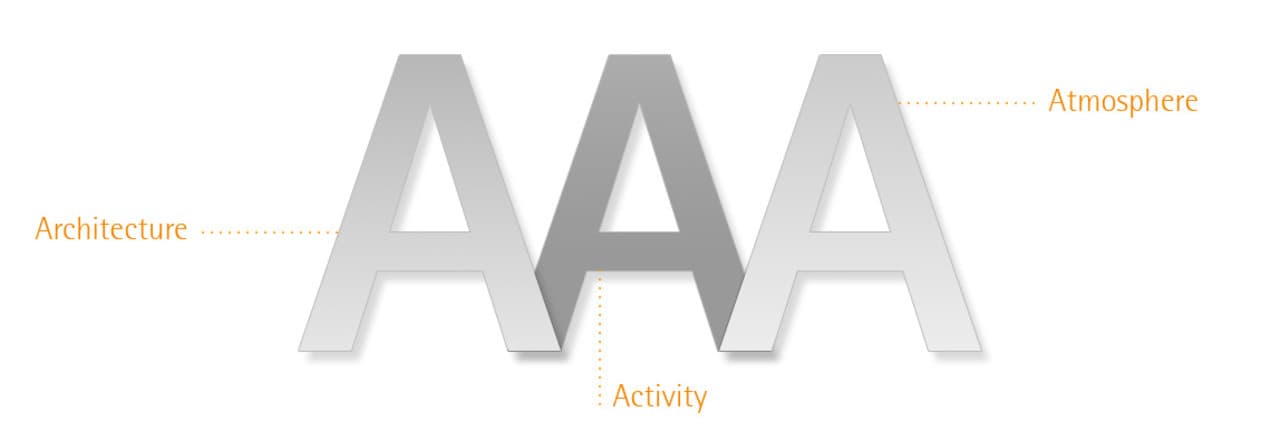
AAA – the ERCO approach to Human Centric Lighting
Lighting simulation and lighting calculation are integral parts of lighting design. They enable the creative development of lighting solutions on the computer.

AAA – the ERCO approach to Human Centric Lighting
Applications range from evaluating experimental concepts through to photorealistic presentations for your clients. The calculation methods allow quantitative analyses to verify the required illuminance levels. To use these tools efficiently, it helps to understand the technical fundamentals. Design and technology are inseparably linked.
The concept of "Human Centric Lighting" has broadened our understanding of lighting quality to include the aspects of health and wellbeing. This brings you closer to your clients. Explain the effect of light on people to your clients, and demonstrate the building blocks that make up a Human Centric Lighting concept. Plan lighting holistically. Alongside the visual effect, consider emotional and biological factors too.
The result is more than just good light: building owners increase the value of their property, users benefit from better lighting quality and greater wellbeing, and designers expand their range of services to include the Human Centric Lighting factor.
Human Centric Lighting does not reinvent lighting design. Perception-oriented lighting design has existed for a long time. What matters is the method: how do you arrive at an efficient, holistic lighting solution? To do so, consistently take three aspects into account: Architecture, Activity, and Atmosphere. Using these terms, you analyse the project and review the design.
What matters is the method
How do you arrive at an efficient, holistic lighting solution?
To do so, consistently take three aspects into account: Architecture, Activity, and Atmosphere. These terms help you analyse the project and review the design.
More about the three aspects
Light for architecture
- Wash the wall uniformly with light. It then stands out as a complete surface and shapes the impression of brightness in the room.
- Bright vertical surfaces also create a balanced contrast ratio between screen and surroundings.
- A brightened ceiling also makes the room appear taller.
Light for activity
- Light the desks with precise zoning.
- This structures the room and creates a high level of visual comfort at the workplace.
- Mounting on the track allows flexible positioning.
- This means the light can be adapted to changing uses at any time.
Light for atmosphere
- Create deliberate focal points!
- They enliven the room and create atmosphere.
- Brightness contrasts emphasise objects effectively and structure perception.
- It works in a similar way outdoors: directed light stages the tree as an eye-catcher.
Lesson completed!
The most important points
- 1Analyse the use, visual tasks, and context before defining the strategy and dramaturgy of your lighting concept.
- 2Apply Human Centric Lighting consistently across the three aspects of architecture, activity, and atmosphere – not just in terms of illuminance.
- 3Wash walls homogeneously with light for balanced contrast at computer workstations, and illuminate desks with additional zone-precise lighting.
Next lesson


