Photometric law of distance: definition and explanation
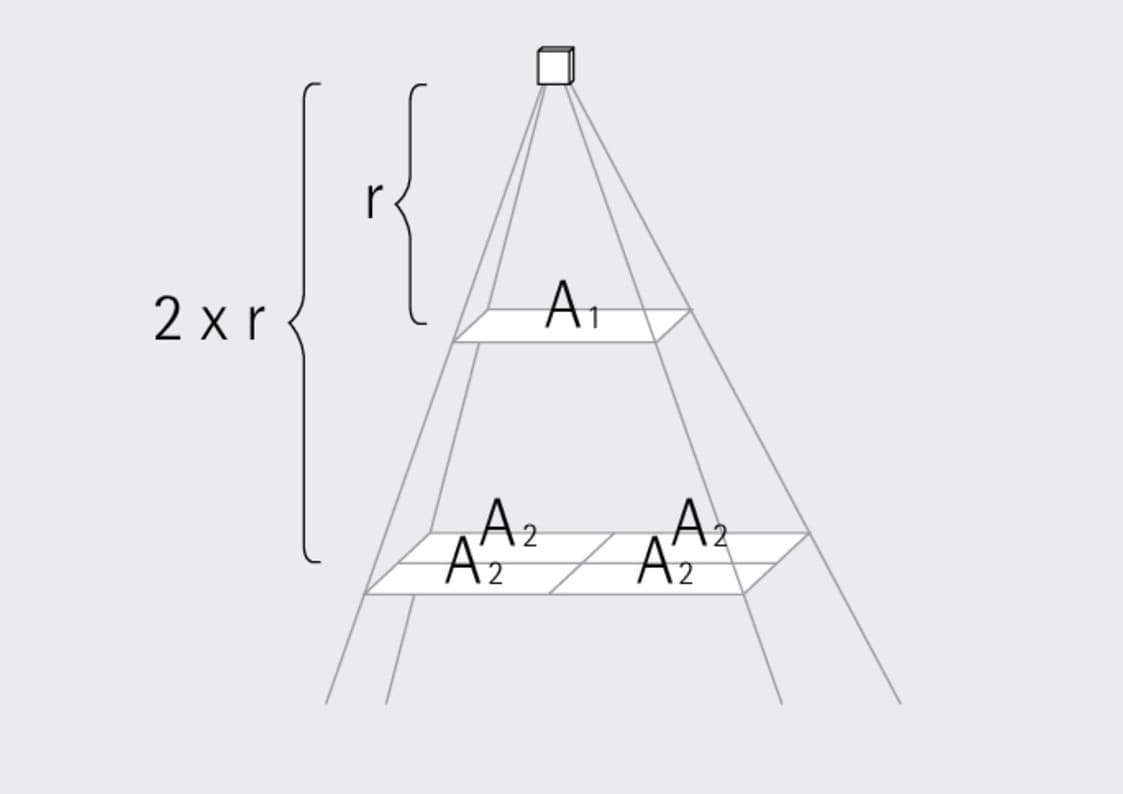
The photometric law of distance describes the relationship between the illuminance and the distance of the measuring plane to the light source. Illuminance recedes with the square of the distance from the light source.
A₁ = Ω x r²
A₂ = Ω x (2 x r²)2 = 4 x R x r² = 4 x A₁
Simplified mathematical derivation:
Illuminance (E) is defined as the luminous flux (Φ) incident on a surface (A) (see formula 1). The luminous flux (Φ) emitted by a light source in this direction is the product of luminous intensity (I) and the solid angle (Ω)(see formula 2). The solid angle (Ω) can be determined from the quotient of the illuminated surface (A) and the square of the distance (r) to the light source (see formula 3).

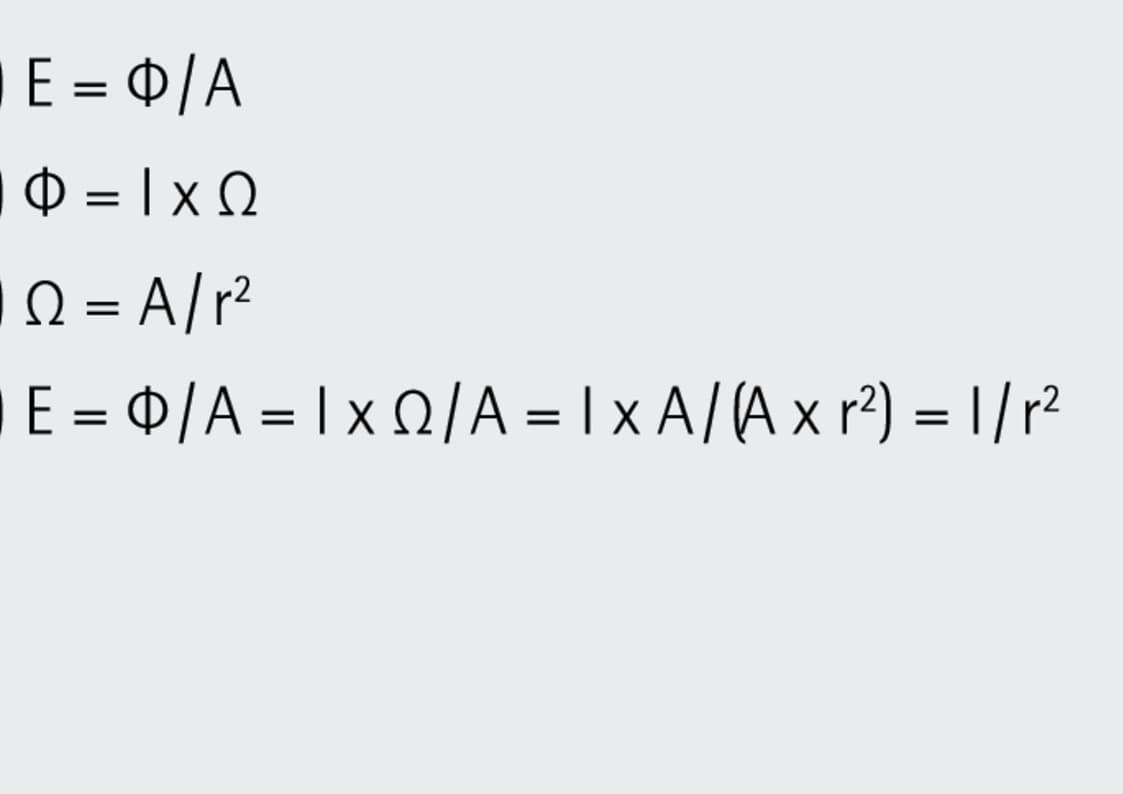
If, in a first step, the luminous flux from formula 1 is replaced by the product of luminous intensity and solid angle, and then the solid angle is replaced by the quotient of the illuminated area and the square of the distance, the illuminance is obtained as a function of the distance to the light source (see formula 4).
Good to know:
The photometric law of distance states that the illuminance decreases with the square of the distance between the light source and the illuminated surface. This means: if the distance between the light source and illuminated surface is doubled, four times the luminous intensity is needed for the same illuminance.


