How can light make public buildings more easily accessible?
Structuring a room with light
Light can make public buildings more accessible and user-friendly. Perception-compliant lighting enables orientation at a glance.
Structuring a room with light
Creating orientation with light
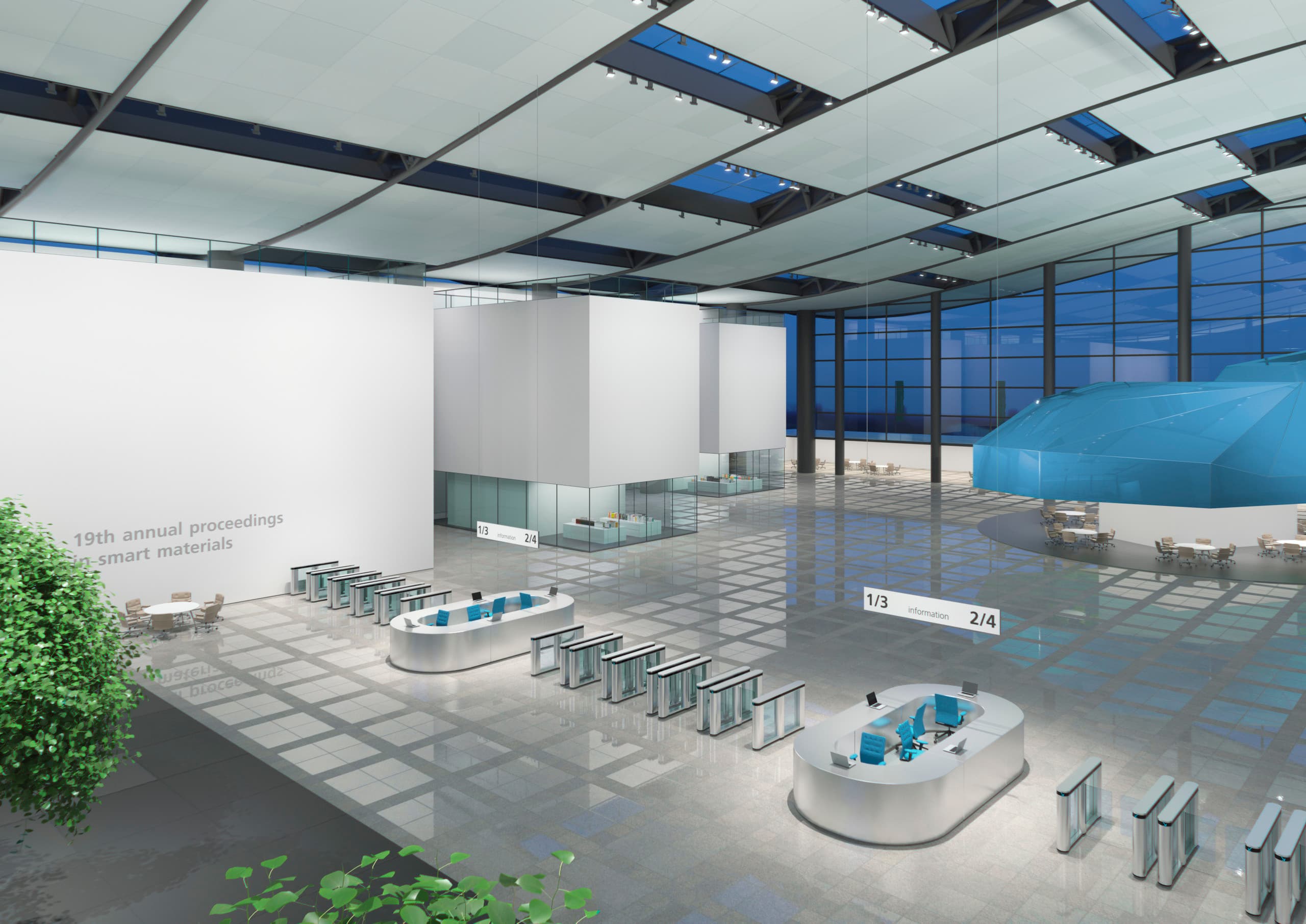
Public buildings should be equally accessible to all members of a society. Concise lighting concepts complying with perceptional needs make such buildings more easily accessible and user-friendly. Part of this is to define and structure large rooms via vertically and horizontally zoned lighting. Contrasts in brightness create hierarchies of importance in the room in this way that support quick, dependable orientation – for new visitors as well as for regular users or employees. The example of an entrance hall demonstrates how light emphasizes the representative dimensions and simultaneously communicates a sense of openness and clearness.
Defining room borders with light
The size and basic shape of a room are part of the central information that we need for orientation. This is why illumination of the vertical room borders via wallwashing is so important. We also judge the brightness of a room based on our primary axis of view, and mainly with vertical surfaces. These can be uniformly and efficiently illuminated using special wallwashers. Wallwashing not only characterizes the impression of brightness in the complete room though but also gives it an extensive, generous appearance. Architectural structures protruding into the room are given a lightweight, almost floating appearance via vertical lighting.
Guiding the view and movement with light
A fundamental principle of perception determines that brightness attracts attention. In practice, this method enables hierarchies in perception to be created with brightness contrasts in the room. Exhibits, constructional elements or zones emphasized with accent lighting serve to attract attention. With this knowledge, lighting designers can establish eye-catchers in the room and guide flows of visitors. The classic instruments for accent lighting are spotlights for track mounting or for recessing in ceilings. These supply brilliant, rich-contrast light for e.g. modelling objects with light and shadow or for emphasizing information areas in a room.
Differentiating areas with light
As part of a perception-orientated lighting concept, the horizontal components for general lighting should also not be monotonous but differentiated according to functions. In this way, via different qualities of light such as brightness and color temperature, zones are created in the room that contrast with each other: for example routes and circulation zones that are attractively delineated via increased brightness. Tools such as double focus downlights help to also concisely divide large rooms with high ceilings into zones via horizontal lighting with good glare control.


ERCO light guide: Community
Planning tips for design and technology