LED binning: definition and criteria
When LEDs are manufactured, scattering with regard to technical properties of the LEDs is unavoidable. For downstream marketing, LED producers therefore subsequently sort their LEDs into "bins" according to defined measurable aspects. The whole process is thus called LED binning.


What are the criteria of LED binning?
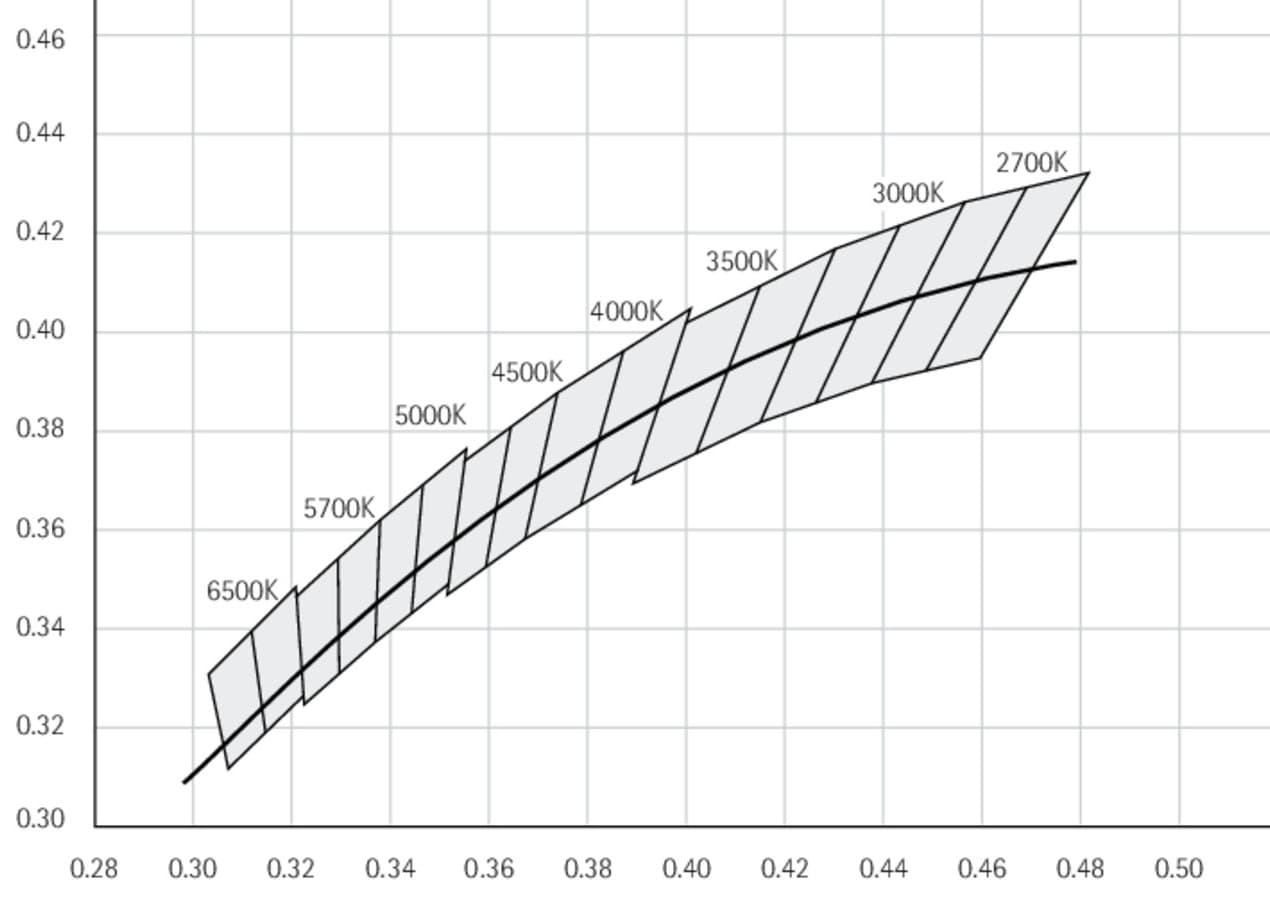
During binning, LEDs are sorted according to exact colour location, luminous flux and forward voltage among other criteria. The colour temperature is already determined before production.
The sorting criteria of an LED binning are:
- The exact colour location, specified as X and Y coordinates of the CIE colour chart
- The amount of light emitted by the LED, the so-called luminous flux, measured in lumens
- The forward voltage (volts). This denotes the voltage that drops across the LED during operation, i.e. that can be measured between its terminals. The forward voltage together with the operating current defines the electrical power of an LED.
For high-quality LEDs and applications nowadays, the binning of colour location and colour temperature is based on the SDCM (Standard Deviation of Colour Matching) ellipses. The previously used bins defined by the ANSI (American National Standards Institute) allowed for clearly visible colour differences.
What is good LED binning?
In the context of binning, grouping takes place with a certain spread for the individual characteristics. The smaller the tolerated spread, the more similar are the properties of the binned LEDs. This is also referred to as a "narrower" bin. The spread within a bin therefore determines the consistency of light quality and efficiency for all luminaires manufactured using LEDs from that bin.


