LED technology: what is an LED?

LED is the abbreviation for "Light Emitting Diode". This is a semiconductor device that emits light when direct current flows through it. The colour of the generated light depends on the structure of the LED chip and the materials used. LEDs are temperature-sensitive dimmable point light sources that emit their light with hemispherical distribution towards the front.
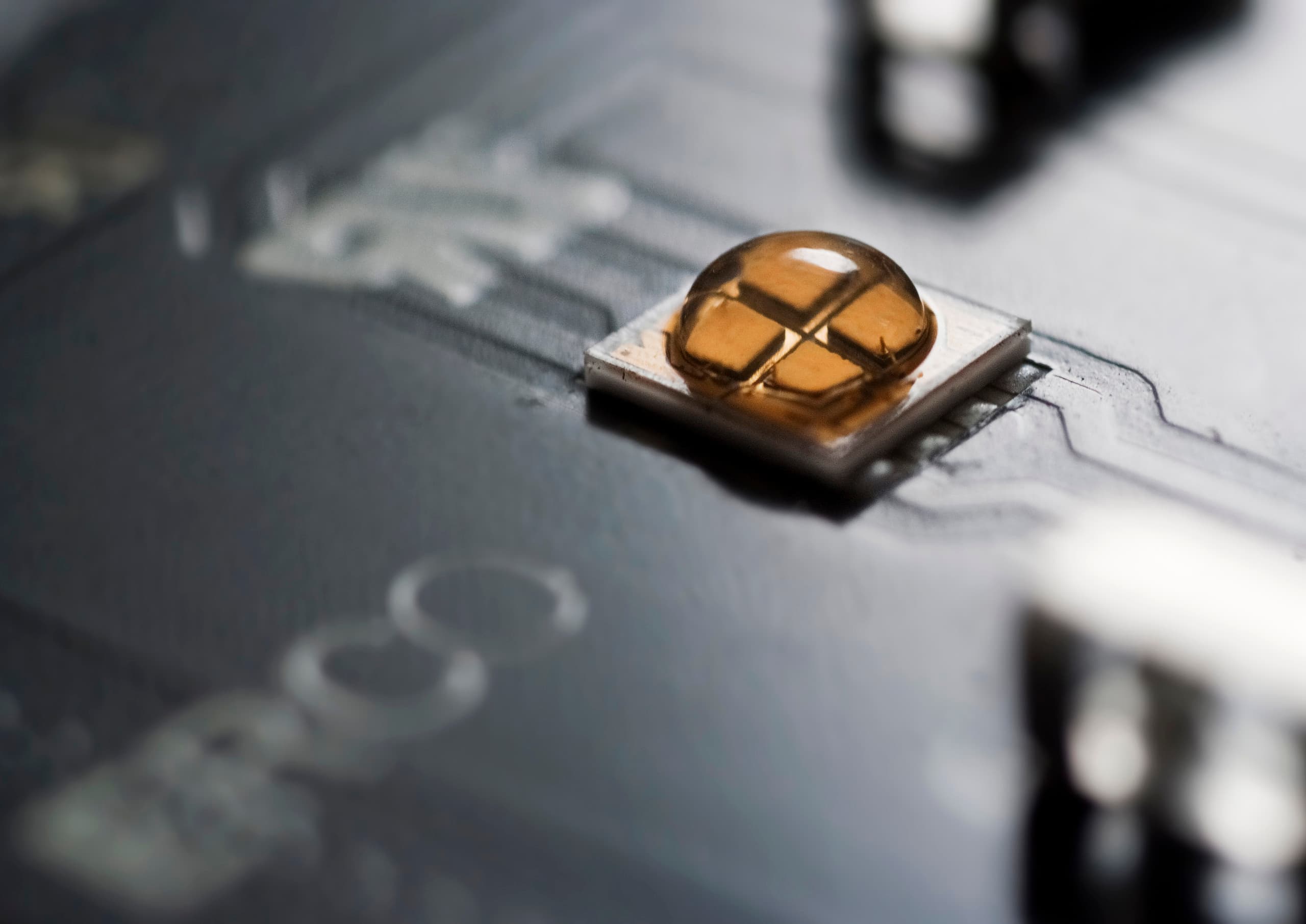


How does LED technology work?
Semiconductor diodes only allow electric current to pass in one direction. During operation, a fixed current flows through the semiconductor layers and a type-specific voltage ("forward voltage" or also "conducting state voltage") drops at the LED. The recombination of charge carrier pairs ("holes" and "electrons") in this process releases energy emitted in the form of light (electroluminescence).
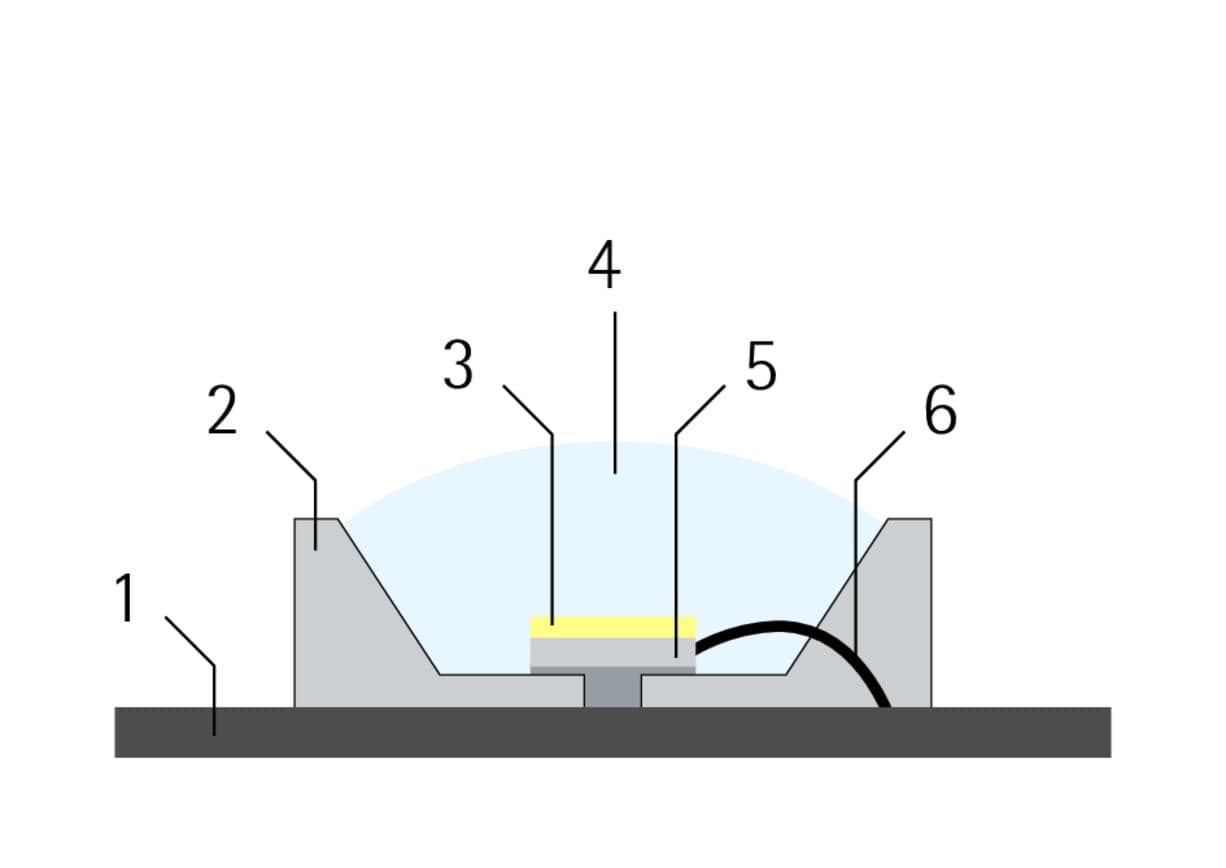
How are LEDs constructed?
In simplified terms, LEDs consist of a substrate on which the semiconductor layers for generating light are deposited. A white glowing LED usually has a conversion layer of phosphor (phosphor compounds), visible to the naked eye as a yellow surface. Depending on the design, the end is formed by a lens that protects the chip on the one hand and, on the other, emits the light.
The precise light colour, colour spectrum and luminous efficacy depend on the semiconductor materials and, with white LEDs, on the type and application thickness of the phosphor in the conversion layer. Scattering of the LED properties are unavoidable in the manufacturing process. For this reason, the LEDs are subsequently sorted into bins according to their light colour and other features – also called LED binning.

How is white LED light produced
White LED light can be generated in two ways:
- A conversion layer (phosphor) consisting of different phosphorus compounds is applied. These phosphorus compounds are excited by the blue light and begin to glow. This is known as "luminescence conversion". The different light colours ranging from warm white to daylight white are produced across the Planckian locus (or "black body curve") by the selection and strength of the phosphorus compounds used. The thicker the phosphor layer the warmer the light colour, but the luminous efficacy (in lm/W) of the LED also decreases. White LED light for lighting purposes generally has little or no UV light component.
- White light can also be produced by additive colour mixing of LED light in the primary colours red, green and blue. However, due to the patchy spectrum, the colour rendering properties of the white light produced are problematic.

LED technology: what is effective thermal management?
LEDs generate heat during their operation – at the same time they are very temperature-sensitive. Thus effective thermal management is needed for high-output, durable LED luminaires. Heat-conducting PCBs (printed circuit boards) and, if necessary, heat sinks, dissipate the heat. This enables LEDs to retain their performance over a long period of time.

LED technology: Which LED designs are used for luminaires?
Today’s luminaires almost exclusively use SMD LEDs and COB modules.
SMD LED
In the "Surface Mounted Device" (SMD) design, the electronic component, in this case the LED, is soldered directly onto the PCB. The PCB is often a metal core PCB that absorbs and dissipates the heat directly at the LED. The small design enables miniaturised projection optics, very defined light distributions and narrow aperture angles.
SMD LEDs are offered with different spectra, colour temperatures and wattages: High-power and Mid-power LEDs. High-power LEDs usually have a power consumption of 1W or more. Luminaires with Mid-power LEDs have a lower luminance at the light-emitting surface and are therefore particularly suitable for applications where glare control is required.

COB modules
"Chip-on-board" (COB) technology assembles LED chips without their own housing directly on the PCB. The chip is encapsulated to protect against external influences. For lighting purposes, these LED designs are often used together with reflectors. The diameter of the luminous surface (LES: Light Emitting Surface) of a COB is a characterising property.
What are the advantages of LEDs?
The use of LEDs in lighting applications has several advantages:
- Very high efficiency in light generation
- Long useful life: luminaires can be operated for many years without changing the light source, giving low maintenance costs
- Very high functional reliability – LEDs are very robust and shock resistant
- Minimal UV and IR components allow reliable conservation applications even for sensitive objects, e.g. in museums and galleries
- LEDs can generate coloured light with high saturation, meaning that very large areas (gamuts) can be covered in any colour spaces
- Smaller designs of LEDs offer new luminaire design options
- LEDs allow highly precise and efficient light control
- Good controllability (dimming): with suitable control gear, very good power control is possible.


