Additive colour mixing: definition and function
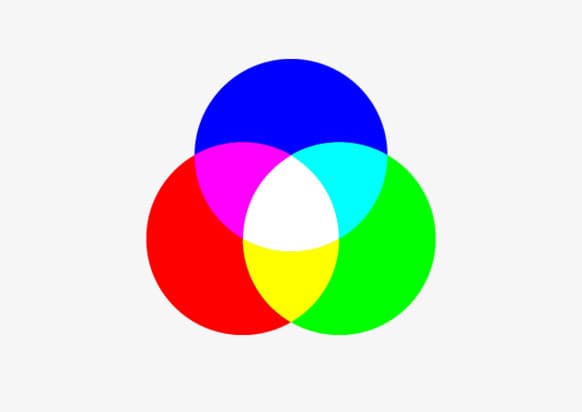
In lighting technology, additive colour mixing refers to the mixing of coloured light by adding spectral ranges. The primary colours of additive colour mixing are the complementary colours red, green and blue. The uniform mixing of the three primary colours generates white light.

How do light colours mix with additive colour mixing?
If the three primary colours red, green and blue are projected separately as light spots (e.g. from an LED spotlight) onto a white surface and uniformly superimposed, new secondary colours are created due to additive colour mixing in the overlapping areas. These are brighter than the original, adjacent primary colours. In addition to light colour, intensity is a property of the light source.
Thus, the additive colour mixing of red, green and blue results in the following secondary colours:
- red and green = yellow
- green and blue = cyan
- blue and red = magenta


Good to know:
In additive colour mixing, when the three primary colours are evenly combined they produce the tertiary colour white, which appears the brightest.
Additive and subtractive colour mixing differ in that in the variant described above, colour is added or colours are combined, whereas with subtractive colour mixing they are subtracted, meaning removed and/or absorbed, e.g. with use of filters.
How does additive colour mixing work in LED lighting?
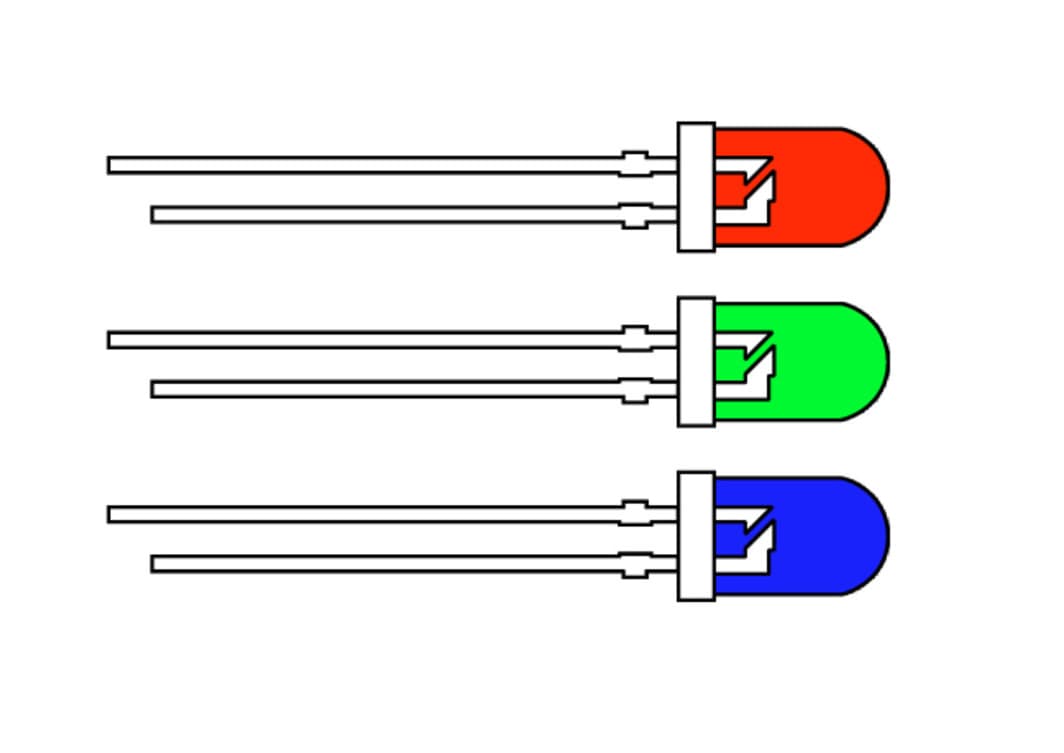
The process of additive colour mixing in LED lighting is used when (coloured) light is to directly reach the eye without reflection, i.e. by projection. This can be observed very well on television screens or computer monitors, because the LEDs of the monitors are constructed with the phosphors red, green and blue (RGB). Due to a physiological addition that takes place in the brain, the impression of a white surface is achieved despite adjacently positioned colour areas.
In lighting design, what added value does additive colour mixing offer?
Electronic control units allow individual light colours or the colour temperature (tunable white) to be modified. In this way, discreet but also very effective colour creations and changes can be achieved, and the perception of colour in works of art can be influenced. This is particularly advantageous in rooms where the uses frequently change: museums and galleries for example can flexibly adapt their lighting to the respective exhibition via additive colour mixing, thus gaining further display options.
In Human Centric Lighting (HCL) applications, a colour temperature adapted to the time of day is also relevant for the well-being of people. Ideally, the lighting concept should take into account the circadian rhythm, i.e. the ‘inner clock’ of human beings, and create a dynamic adaptation of the course of daylight.


