LED: what is tunable white?
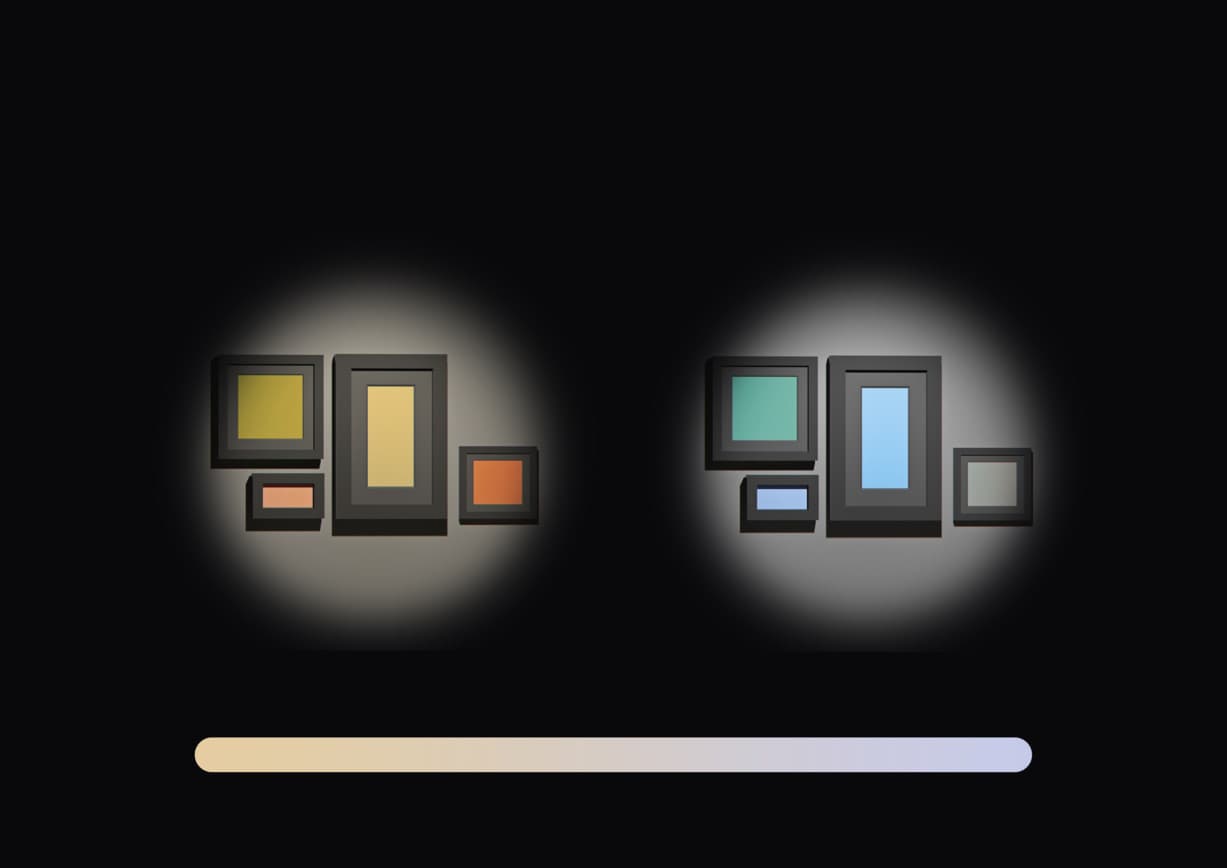
White light can look very different, e.g. from yellow-orange "warm" to bluish "cool". Tunable white means that luminaires with this technology are adjustable in terms of their colour temperature. A setting range of 2700 to 6500K is usual here.
This technology is often used for HCL (Human Centric Lighting) to simulate the variation of natural daylight, or for illuminating exhibits and architecture.



How is tunable white implemented in an LED luminaire?
For tunable white, LEDs with different light colours are mixed on a PCB so that they can be separately controlled. Depending on the characteristics of the LEDs, colour temperature ranges from warm white (e.g. 2700K) to daylight white (e.g. 6500K) can be set.
To bring the achieved spectra even further towards lower or higher colour temperatures, the white LEDs can be supplemented with red or blue LEDs.
An important criterion for the quality of a tunable white luminaire is uniformity of power output, luminous flux and colour rendering in all the settings. To achieve this, the LEDs used as well as the control gear must be optimally matched and calibrated as far as possible. Both High-power LEDs and Mid-power LEDs are available for tunable white.
How are tunable white luminaires controlled?
Special control gear units are assembled in the luminaire for operating and controlling tunable white luminaires. These can be controlled via lighting control systems such as DALI and Casambi Bluetooth.


