Colour rendering of LEDs

Colour rendering generally refers to the ability of a light source to render colours as "true to nature" as possible. Colour rendering is a property of light sources. It depends on the spectral composition of the light emitted by the respective light source and not on the light colour (colour temperature) itself. Common methods of evaluating colour rendering are the CRI and the TM-30 method.


What is the colour spectrum of an LED?
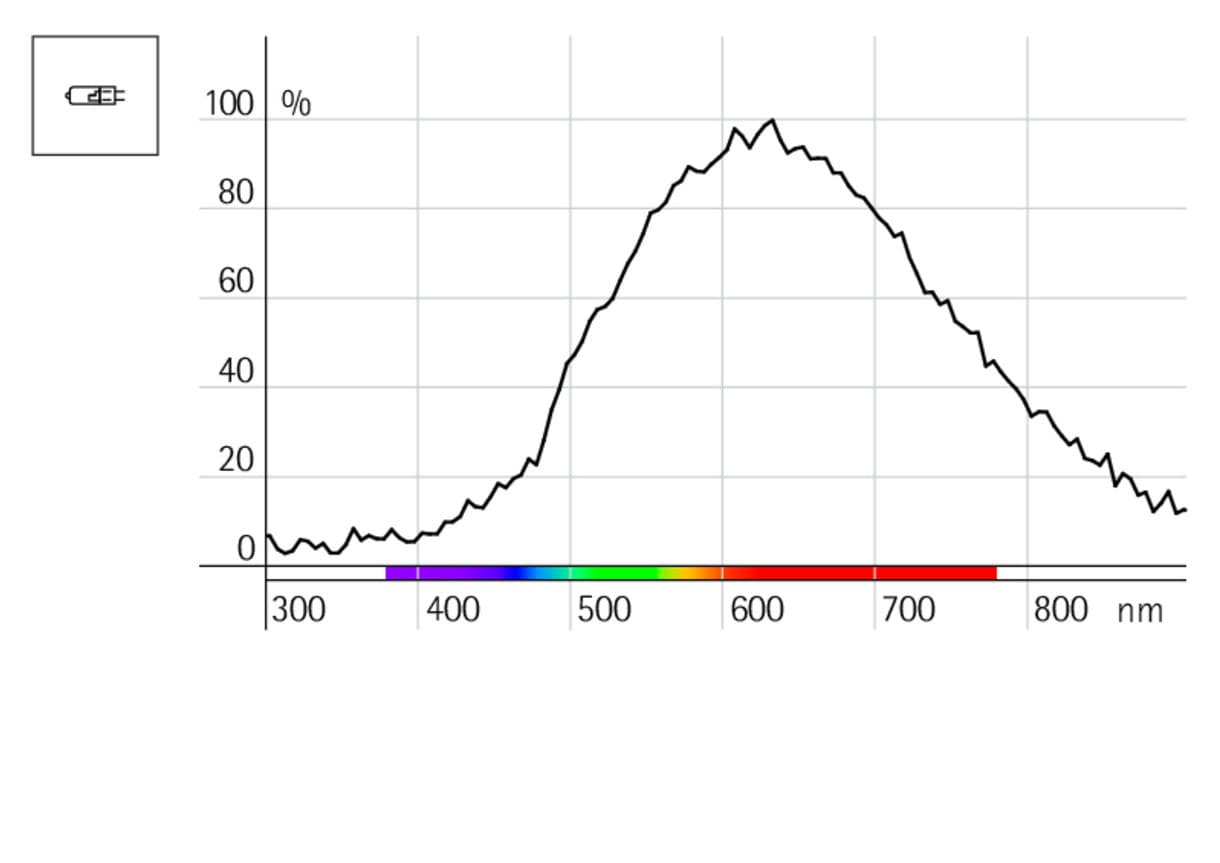
Light sources such as incandescent lamps or the sun which emit light due to high temperatures have a spectrum that includes all areas of the visible spectrum. For this reason, the colour rendition is very good.

The spectrum of white LEDs is less uniform because of light generation by semiconductors and phosphors. It drops significantly at the edges of the visible area, with stronger components and gaps in between. The spectrum of common white LEDs is made up of the narrow component of a blue LED and the broader component produced by phosphors. LEDs with better phosphors and a more uniform spectrum show better colour rendering properties.
Spectrum 1 depicts an LED with good colour rendering, and spectrum 2 an LED with very good colour rendering.

What does the colour rendering index CRI mean with LEDs?
The colour rendering index CRI, also called Ra in German-speaking countries, is the most common method of representing the quality of colour rendering in a measurable way and as objectively as possible.
To determine the LED colour rendering index CRI, the light source to be evaluated is compared with a reference light source (either an incandescent lamp or the standardised illuminant D65 for "medium daylight", depending on the light colour). The comparison is made for test colours R1 - R8 (exclusively pastel colours), and the arithmetic mean of the colour rendering of these 8 test colours gives the general colour rendering index CRI.
The maximum achievable CRI value is 100. A CRI value higher than 80 is considered "good", and values above 90 are classified as "very good".

A weakness of the general colour rendering index CRI is the assessment of colour rendering over only 8 pastel colours with no consideration of saturated hues. Red hues in particular are relevant in many applications (e.g. fashion, cosmetics, food) and are not considered in the CRI. In the procedure for determining the colour rendering index, 6 additional test colours have therefore been defined for which colour rendering can additionally be determined and specified for more detailed assessment. Saturated red is test colour 9, and the colour rendering for red is therefore known as "R9" and is often given as a supplement due to its high relevance for applications. With white LEDs, values of R9 > 50 are already considered very good, and values of > 90 are excellent.
Which CRI values apply to indoor spaces?
The CRI value should be at least 80 in indoor areas where there are people. The European standard DIN EN 12464-1 for the lighting of indoor workplaces specifies minimum requirements for different work areas and visual tasks. The more important the correct evaluation of colours is for the respective activity, the higher are the requirements for colour rendering – maximum requirements are found, for example, in the health sector.

What does TM-30 mean with the colour rendering of LEDs?
As an alternative to the CRI method, the American standard TM-30-20, harmonised with CIE 227, defines the values Rf and Rg. These refer to the similarity of a test light source to a reference spectrum in terms of colour fidelity (Rf - fidelity) and saturation (Rg - gamut). The reference light source is a standard CIE-D light source corresponding to daylight.
Rf is comparable with CRI and the calculation method and maximum value of 100 are identical. By considering 99 instead of 8 reference colours, lower values often result with Rf compared to CRI.
Rg specifies the colour range, i.e. the size of the displayable colour space. A light source with precise, true-to-nature colour rendering has an Rg value of 100; both smaller and larger values are possible.
Rg values above 100 are an indication that colour hues are particularly emphasised and rendered more strongly than those produced by the reference light source.

The Rf and Rg values are usually shown in a diagram. However, this alone does not provide definitive information about the colour rendering quality of a lamp. This is only possible with the colour vector graphic that displays the size and direction of colour shift for selected test colours compared to a reference light source.
If the determined curve is located outside the circle valid for the reference, colours in this area are rendered with oversaturation. If it lies within the circle, the corresponding colours are rendered with a lower saturation.


