Adaptation (eye): adaptation to different lighting conditions
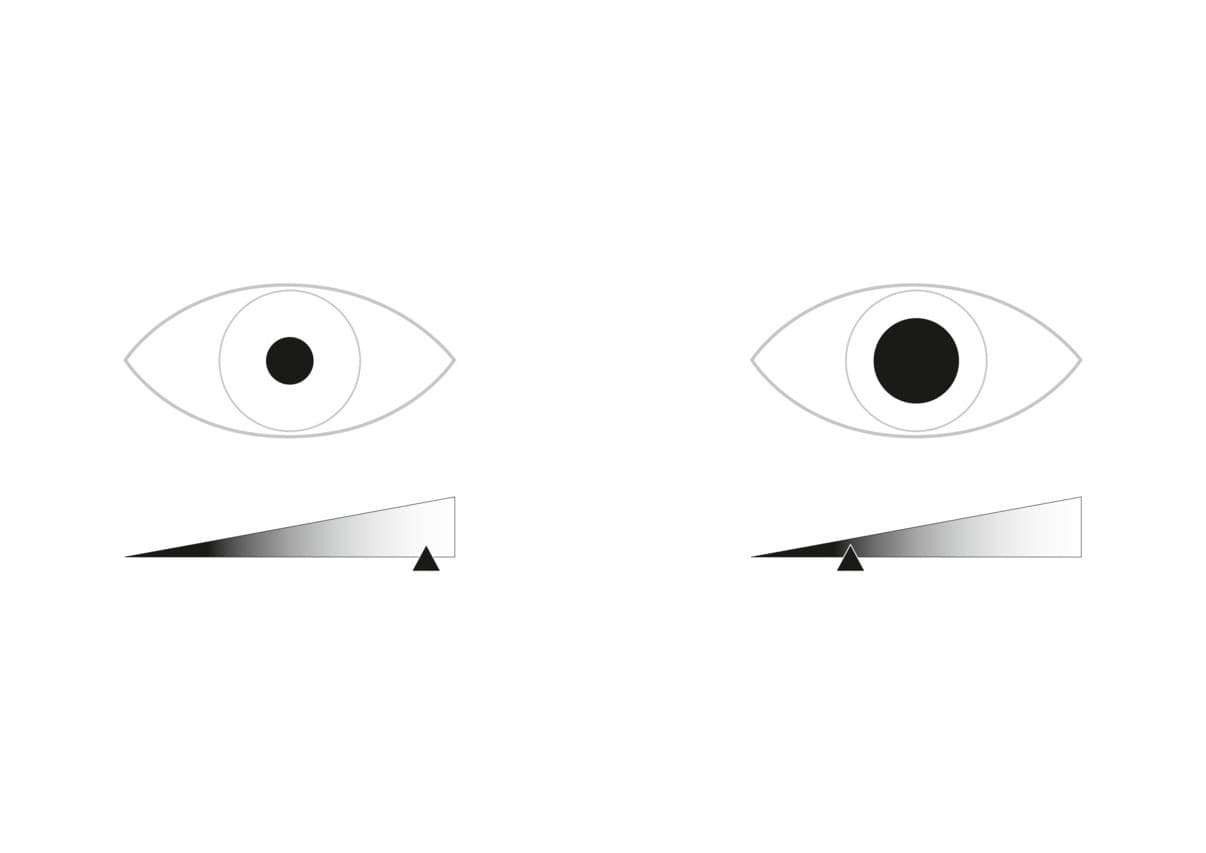
Adaptation is the adjustment of the eye to different luminances. When changing from light to dark and vice versa, adaptation is initially performed by enlarging or reducing the pupil. Most of the adaptive capability is provided by two photoreceptors on the retina. The rod receptors are effective in the dark, i.e. in the area of night vision (scotopic vision), the cones enable day vision (photopic vision), whilst in the transitional area of twilight vision (mesopic vision) both receptor systems are activated.


What is meant by adaptation of the eye?
One of the most remarkable feats of the eye is its ability to adjust to different
lighting conditions. This process is called adaptation. We perceive our environment in moonlight as well as in sunlight, although illuminance in these situations differs by a factor of 10⁵. The efficiency of the eye extends over an even wider range – a star faintly shining in the night sky is still perceived even though it only reaches an illuminance of 9.3x10⁻¹⁴Fc. (10-12lx) in the eye.

Light-dark adaptation
The transition to dark rooms requires the eye to adapt, because the eye cannot process all visible luminances simultaneously but only adapts to limited brightness ranges. When going from outdoor to indoor spaces, for example in an exhibition that has to work with lower lighting levels due to conservational aspects, it is advisable to take this adaptation time into account and provide intermediate spaces with decreasing brightness. Once the eye has adjusted to a darker surroundings, even low intensity lighting can be sufficient to create a bright impression.
Dark-light adaptation
Adaptation to a brighter environment occurs much faster than adaptation to dark. For example, leaving a dark interior room towards intense sunlight is considered less critical than going from lit rooms into nocturnal environments. Compared to the adaptation efficiency of the receptors, the pupil only makes a very small contribution to brightness adaptation.
Why is light adaptation faster than dark adaptation?
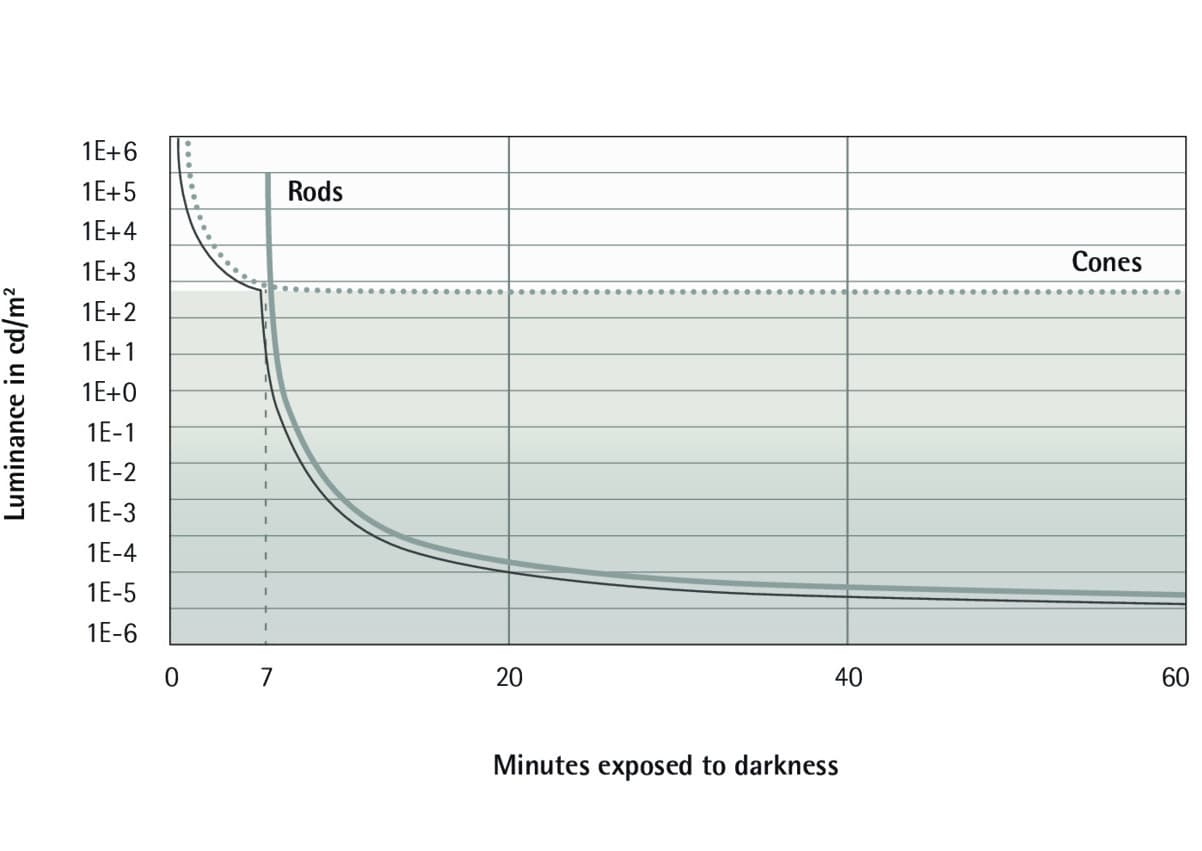
Everyone is familiar with this: when moving from dark to light surroundings, the eyes "get used" to the brightness much faster than the opposite way into darkness. With light-dark adaptation, often only called dark adaptation, switching from cone vision to rod vision takes place and the pupils dilate to let as much light as possible into the eye. Rhodospin is formed in the rods to transmit incoming light stimuli to the brain. Colloquially, this visual pigment is also called visual purple. It can take up to 30 minutes for the eye to adjust to the dark environment.
The cones are relieved, which leads to a decrease in visual acuity and color perception as darkness increases.


Good to know:
Brightness adaptation, i.e. adaptation to well-lit environments, works within seconds. Dark adaptation on the other hand is a slow process; it can take 30 minutes for the eyes to adapt to dark conditions.
What is a chromatic adaptation?
Chromatic adaptation is the white balance of the eye. The change in light color is at the center of the adaptation process. The receptors in our eyes are capable of correcting spectral shifts in light – for example, when going from an outdoor space to an indoor space illuminated with artificial light. Thanks to this process, the color impression of an object, for example a white sheet of paper, remains identical.


